
Bulb codes like ST64 and ST19 often confuse buyers. Lighting buyers find it complex to find the bulb that best suits their requirements. With different types of light bulbs available, choosing a suitable light bulb is challenging.
But don’t worry! This guide will help you in choosing the best light bulb by providing a detailed ST64 vs ST19 comparison.
What Does ST64 vs ST19 Mean?
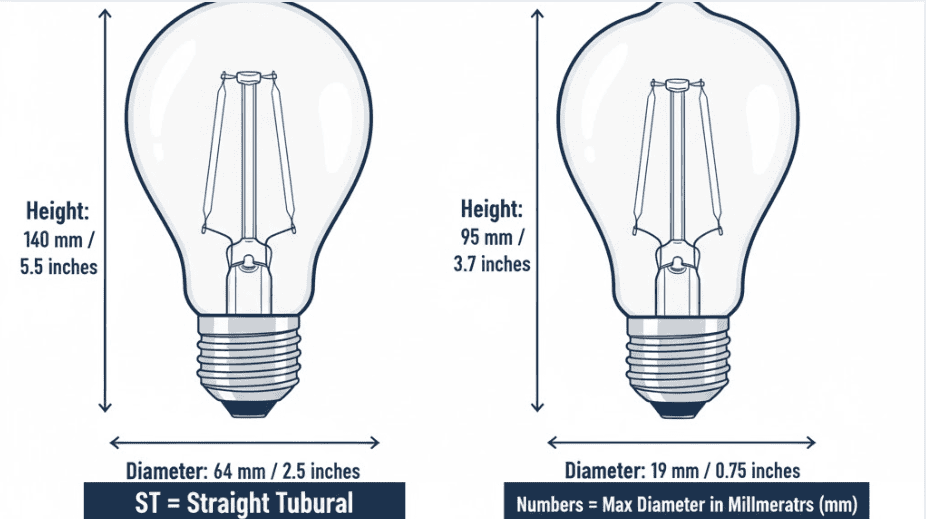
Simply stated, ST64 and St19 are bulb codes that provide a bulb with its unique identity. Every bulb has a different code from others, and this code is what explains the shape and diameter of bulbs.
The ST in bulb codes stands for Straight Tubular. ST refers to the typical Edison-style bulb shape. As for the number that follows ST in codes, it refers to the diameter of the bulb.
In the ST19 code, the ever-famous imperial measurement system is used. You can calculate the diameter of this bulb very easily as 19 × 1/8 inch = 2.375″. Compared to the ST19 bulb, the ST64 Bulb uses a metric measurement system. The diameter of this bulb is 64mm = ~2.52″.
The difference in the measurement system arises because of the difference in markets. A clear understanding of imperial vs metric systems helps buyers in making the right choice.
ST64 vs ST19: A Quick Comparison Table
The table below compares ST19 and ST64 bulbs based on their shape, size, and applications:
| Feature | ST19 Bulb | ST64 Bulb |
|---|---|---|
| Diameter | 2.375 inches with a compact design ideal for smaller fixtures. | 2.52 inches. This bulb is ideal for use in chandeliers or decorative lighting |
| Height | 5.375 inches. It is a medium-length bulb that works well in smaller spaces. | 5.4 inches. It gives a prominent look and goes well with vintage fixtures. |
| Shape | Short & round, ideal for a compact aesthetic that blends into modern lighting setups | Long & narrow. These bulbs are often associated with Edison-style filament bulbs and feature vintage light bulb shapes. |
| Style | Modern and minimalist. Best for well-defined interiors and spaces needing effective lighting solutions | Ideal for settings that need aesthetic lighting, such as cafes or vintage-themed restaurants |
| Common Uses | Often used in desk lamps and sconces | Mostly used in decorative settings |
Despite the discrepancies, both bulbs usually use the same E26 base.
What is an ST64 Bulb?
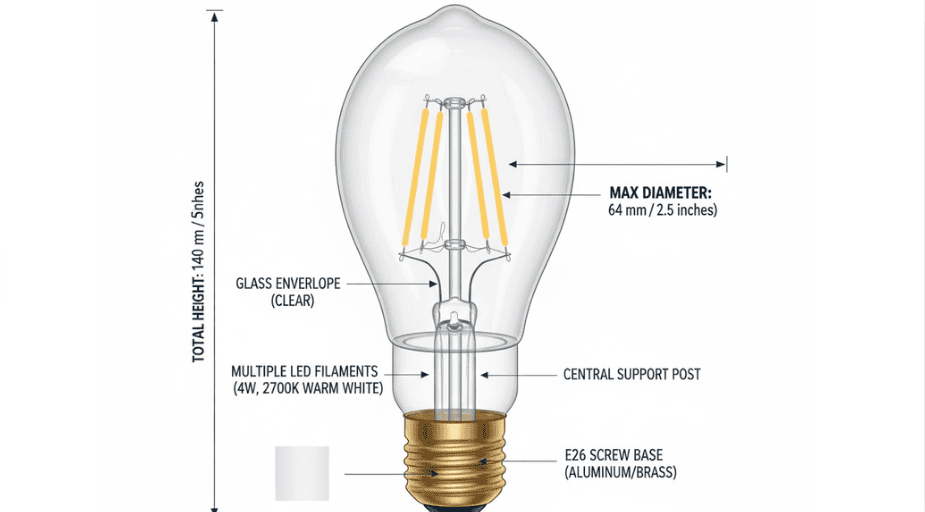
ST64 bulbs have a height of 5.4 inches and a diameter of 2.52 inches. The look of this bulb is elongated, and these bulbs are popularly used in residential and commercial settings.
The ST64 bulbs are frequently used when the light fixtures are open or when a vintage feel is desired. As ST64 delivers a bright and uniform lighting distribution, it is the best type of light for warehouses, industries, and restaurants.
What is an ST19 Bulb?
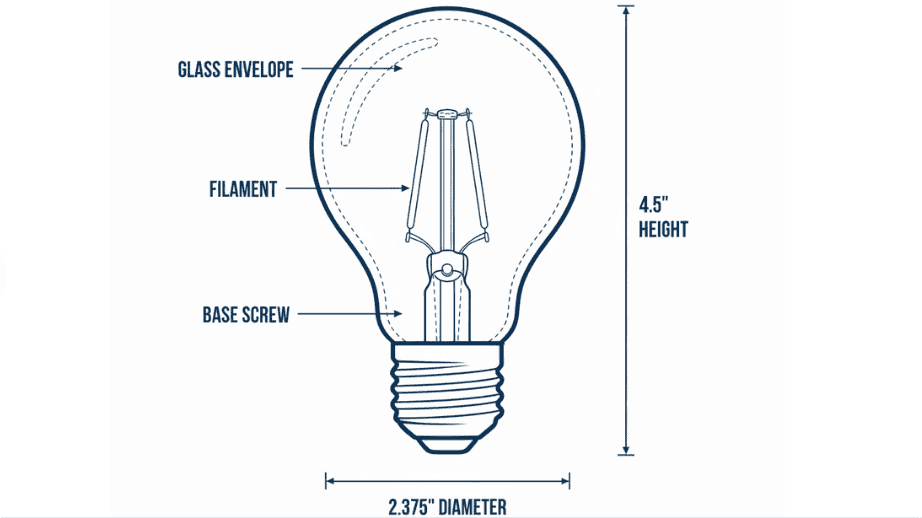
This Edison-style bulb measures around 5.375″ high and 2.375″ wide. It is smaller than the ST64, hence it is ideal for smaller workspaces.
This bulb comes in handy when the light fixtures are small or enclosed. ST19 bulbs are frequently installed in compact or enclosed places, such as ceiling fan lights, different types of chandeliers, vanity lights, wall sconces, and table lamps.
These bulbs provide a balance of lighting and aesthetics, and are thus common in indoor lighting fixtures.
ST58 vs ST19 – Are They the Same?
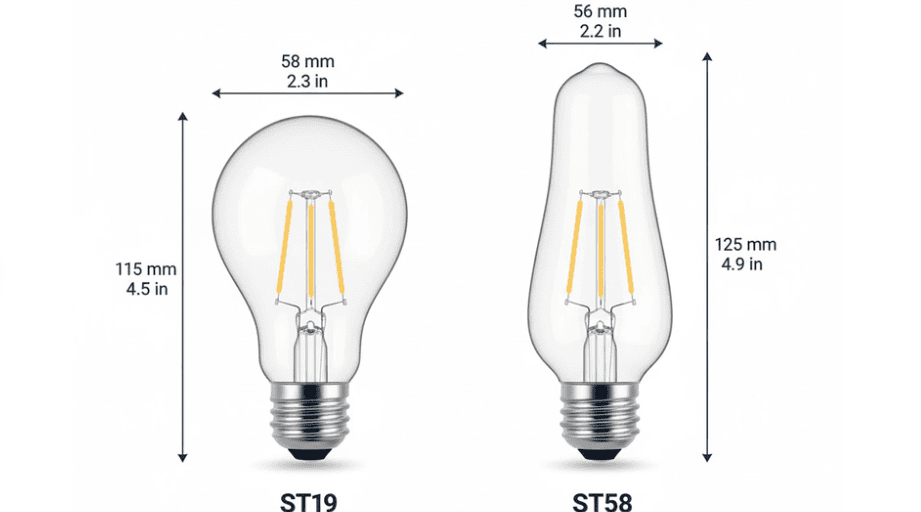
In a true sense, both of these light products are similar. The only difference between these bulbs is in terms of labelling:
- ST19 uses the imperial system (i.e., 2.375″ diameter) and is widely used in the US.
- ST58 uses the metric system (i.e., 58 mm diameter) and is frequently used in the European market.
Both these LED Edison light bulbs share identical dimensions, and this is the reason that they can be used interchangeably if the light fixtures allow.
ST19 vs A19 – Shape Comparison and Compatibility
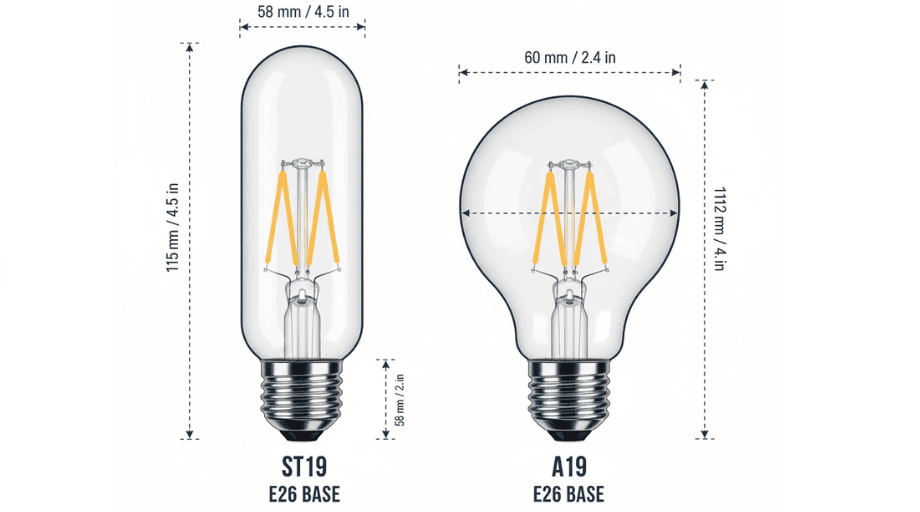
ST19 and A19 are commonly used LED Edison light bulbs. They both share the same size and E26 base but differ from each other on the basics of their appearance.
The A19 bulb is commonly used in residential settings, i.e., in kitchen, bedroom, and ceiling fixtures. The bulb features a rounded top with a traditional look. ST19, on the other hand, boasts a more tubular and elongated shape with a vintage look.
Thus, it is commonly used in decorative lighting. The comparison between ST19 vs A19 and A19 vs A21 Light Bulbs guides and allows businesses to make the ideal decision.
ST19 vs E26 – What’s the key difference?
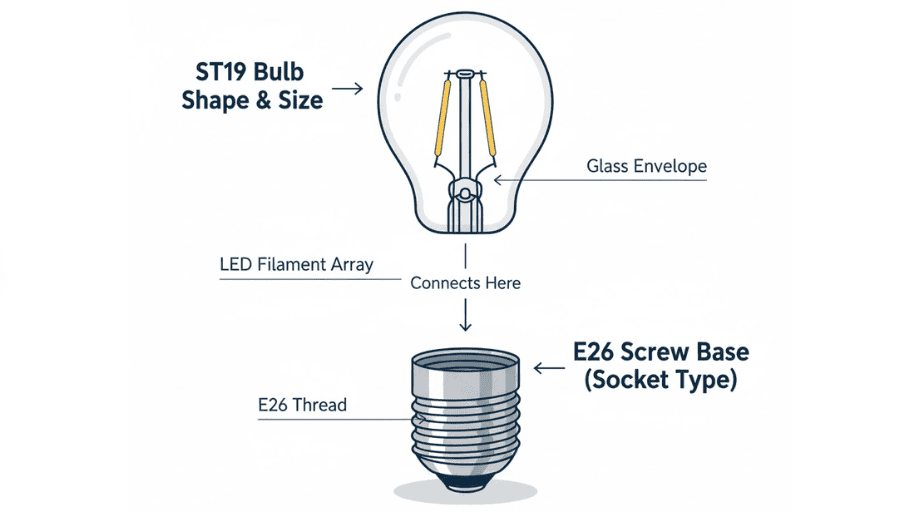
The comparison of ST19 vs E26 often confuses DIY decorators, as they consider only the bulb’s look. But in reality, the difference between the ST19 and E26 bulbs is in terms of basic terminology. Both these terms can be used together as they refer to different characteristics.
ST19 refers to the bulb’s look, while E26 refers to the bulb base size. You may come across a bulb labelled ST19 with an E26 base.
This means that the bulb has a vintage body with a diameter of 2.375 inches and can fit into typical US sockets.
Regardless of the bulb selection, opt for models with high IP ratings to ensure resistance against dust and moisture. Choosing a high-rated bulb is equivalent to choosing a bulb with a long lifespan.
Edison Bulb Shape & Size Chart: ST18, ST64, A19, G25 & More
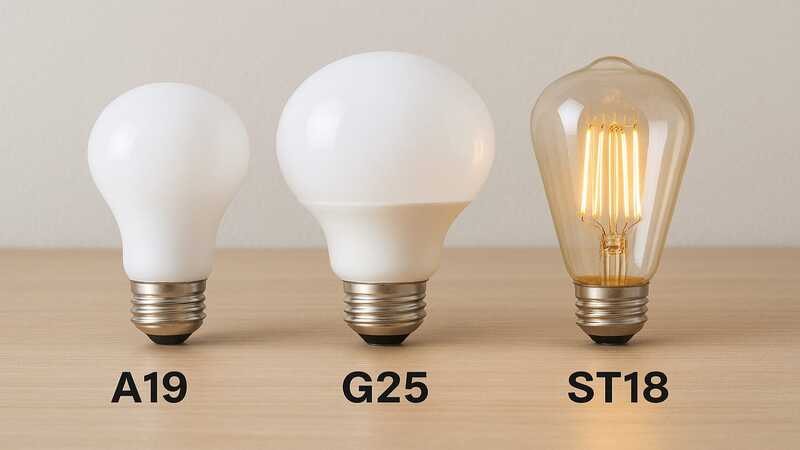
An LED Edison light bulb chart featuring both imperial and metric codes, along with the shape description, is given below:
| Imperial Code | Metric Code | Shape Description |
|---|---|---|
| ST18 | ST58 | A slim and tabular bulb, which is perfect for creating a vintage feel in interior settings |
| ST19 | ST58/60 | A moderate-sized bulb with an aesthetic look, suitable for both stylish and transitional places |
| ST21 | ST64 | Large modern bulb with a remarkable presence. |
| A19 | A60 | Common bulbs used in homes offer versatile lighting for everyday needs. |
How to Choose the Right Edison Bulb for Your Fixture?
Homeowners cannot just choose a light for bedrooms as it is dimmable. Similarly, industrial buyers cannot just choose a cheap commercial lighting source.
Many different factors should be considered when selecting an Edison bulb for your lighting applications. Below are key considerations to guide you with your decision-making process:
1. Fixture Size:
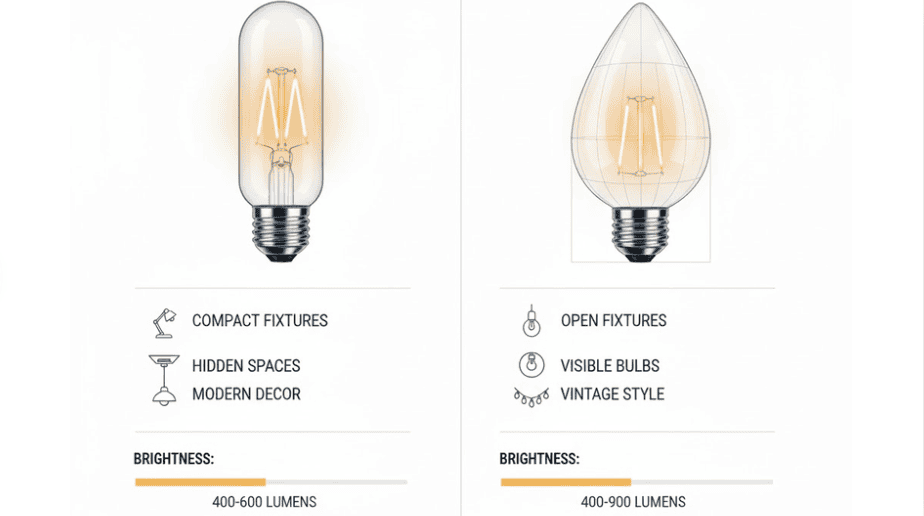
The first thing you should consider while choosing the Edison light bulb type is fixture size. If the fixture is tight or enclosed, choose ST19 bulbs. If the fixtures are open and large, go for ST64 bulbs.
2. Visibility:
If you, as an interior stylist, consider that the bulb should be visible or exposed, then go with ST64. ST64 is an attractive and vintage bulb, thus enhancing the overall look.
Similarly, if the bulb is to be installed in a place that is hidden, ST19 is the best choice. The reason behind this is that ST19 is compact, so it fits well in smaller spaces.
3. Decor Style: Vintage vs Modern
In transitional spaces, ST19 light bulbs give a modern look. On the other hand, if you want to provide your space with a vintage aesthetic, choose ST64.
4. Lighting Application:
ST64 is utilised in ceiling fan lights, string lights, and kitchen pendant lights. For desk lamps, vanities, and other compact spaces, use ST19.
5. Brightness Needs:
The lumens-to-watt ratio or the brightness requirements also influence the bulb choice. ST19 produces 400–600 lumens. Whereas ST64 produces higher lumens, i.e, 400–900 lumens, it is ideal for places requiring brightness.
The only issue that may be incurred while using these bulbs is an increased electricity bill. Be sure to consider the bulb’s voltage to lower your electricity bill; a lower-voltage bulb utilises less electricity, thus saving on energy and costs.

Conclusion:
There are many ways to light up a home or commercial space, and choosing the right one is important. Now that you have a different light bulbs comparison, including ST19 vs ST58 and ST58 vs ST19, it’s time to take action.
Understand and decode the bulb code meanings to make a suitable choice. Also, don’t just retain your focus on the light bulb type; make sure to choose a reliable supplier, too.
Opting for a reliable supplier can provide you with a competitive advantage in the long run. So, try to account for factors that will assist you in choosing the right lighting supplier.
A Trusted Partner for All Your Lighting Needs
With 13+ years of experience, Risun Corp is a trusted partner for all your lighting needs and business. Our commitment to excellence puts us way ahead of our competitors.
Our expert team utilises an innovative approach to deliver tailored lighting solutions. With a deep understanding of the market, we continue to meet the changing demands of our clients.
So what are you waiting for? Contact us today to get a custom bulk quote.
FAQs
Q1. What does ST64 mean on a lightbulb?
ST64 is a light bulb code that defines the shape and size of a bulb. ST stands for Straight Tubular, while 64 indicates the bulb’s diameter in mm.
Q2. What is the difference between ST64 and ST18?
The main difference between the mentioned bulbs lies in their dimensions. ST64 bulbs are typically larger and wider compared to ST18 bulbs. Both ST64 and ST18 are vintage-style bulb shapes and are suitable for different fixtures.
Q3. What size base is an ST58 bulb?
An ST58 light bulb typically features a base size of E26. E26 is a standard screw size for most lighting fixtures, specifically in North America. The ST58 bulb’s compatibility with several fixtures makes it a popular choice for residential and commercial use.
Q4. Are E26 and A19 the same?
E26 and A19 are not the same. E26 refers to the base type, a 26mm Edison screw, while A19 describes the light bulb shape and size. Many A19 bulbs utilise an E26 base, but these terms are not interchangeable.
Who invented the light bulb—was it Edison, Tesla, or someone else? In this post, we’ll clear up the confusion and reveal the key players who brought light into our homes.
Drawing on historical facts and expert analysis, we’ll separate myth from reality in one of the greatest rivalries in tech history.
You’ll discover how Edison’s direct current and Tesla’s alternating current shaped the future of electricity. Ready to uncover the truth behind the bulb? Let’s get started
The Evolution of the Light Bulb: Who Invented It?
The invention of the electric light bulb was a gradual process involving inventors over several decades. Humphry Davy established lighting history in 1802.
He created an electric light using carbon electrodes with an electrical current flow. This invention became known as the first arc lamp. It was impossible to use due to its extreme brightness and short operating time.
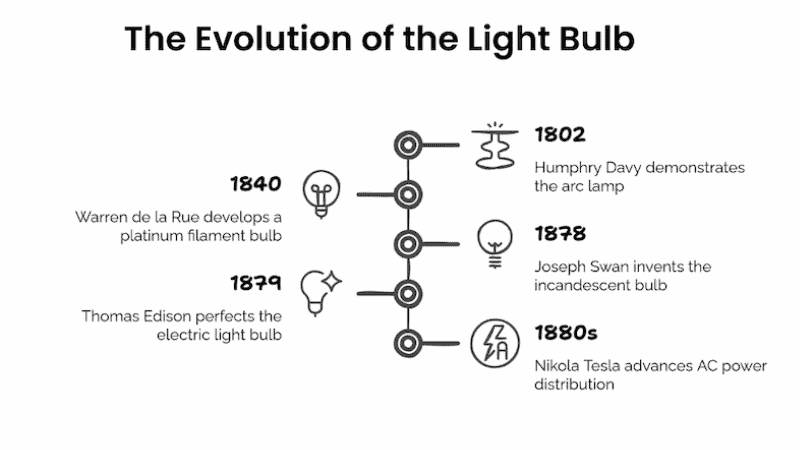
The lighting technology improved in 1840 when Warren de la Rue contained a coiled platinum filament inside a vacuum tube. It was too expensive to produce on a large scale.
In 1860, Joseph Swan created a primitive incandescent bulb with carbonized paper filaments inside a vacuum. Joseph Swan perfected his electric bulb design, which led to practical electric illumination.
During a similar period in 1874, Alexander Lodygin invented an incandescent lamp by using carbon filaments. He uses inert gases for improved bulb performance.
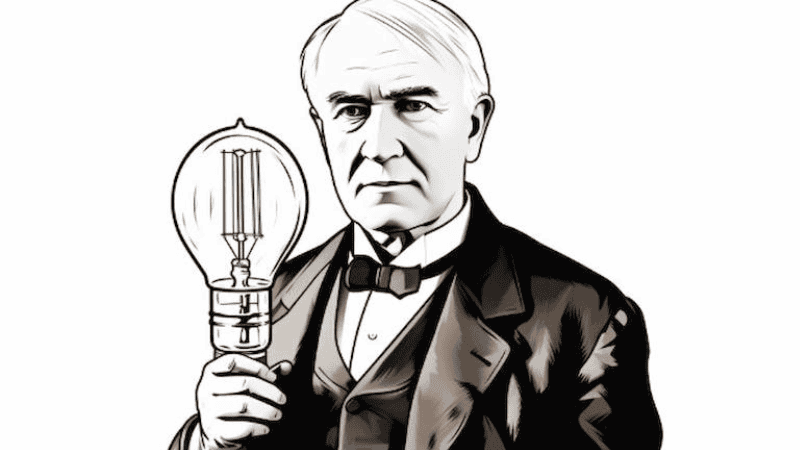
In 1879, Thomas Edison received a patent for his forty-hour carbon filament incandescent bulb. In 1880, he elevated the life expectancy of his electric lamp to 1,200 hours by applying bamboo fiber filaments.
Edison’s power stations and networks made electric lighting accessible for homes and businesses.
In parallel, Nikola Tesla worked on essential electric power distribution system advancements. Tesla’s introduction of AC power proved superior for extending electricity across long distances.
It performed better than Edison’s DC scheme. Tesla also worked on wireless energy transmission research. He also advanced the development of both fluorescent and neon lighting devices.
His inventions of light were accessible for broad consumer use. He did not take part in creating the incandescent bulb itself.
In modern times, the incandescent bulb maintains popularity because people favor its low cost and easy use.
Thomas Edison’s Contributions to the Light Bulb
Thomas Edison is best known for developing a practical incandescent light bulb. He also founded the Edison Electric Light Company. In 1882, he powered Manhattan with direct current (DC), marking a major milestone.
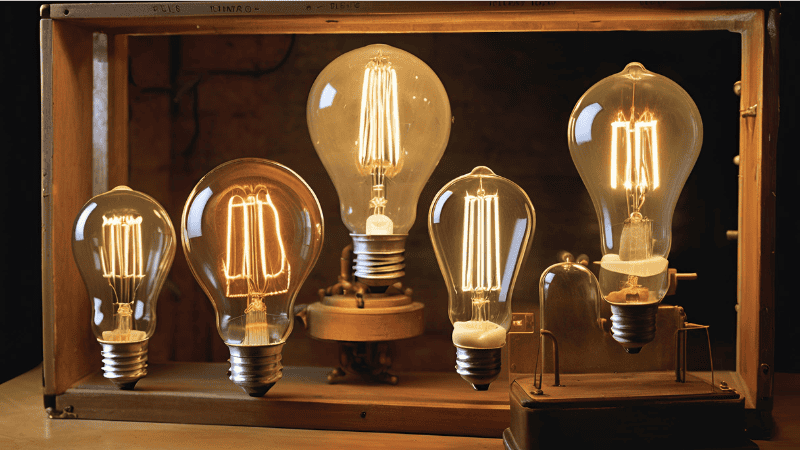
The invention of the incandescent light bulb reached its final practical form when he added carbon filaments. The inventions led to durable light bulbs, which became cost-effective options for daily usage.
After creating the light bulb, Edison dedicated himself to developing the system as a whole. He established every component required to distribute electricity on a large scale. He developed generators combined with distribution networks and electric metering technology.
In 1882, the Pearl Street Station brought electric power to residential and commercial customers.
Through commercial operations, Edison caused a revolutionary shift in lighting technology. This invention removed gas lamps and established the basis for contemporary electrical systems.
Nikola Tesla and His Role in Electrical Innovation
Nikola Tesla’s groundbreaking technologies changed the way we use electricity. He helped create the foundation for modern power systems.
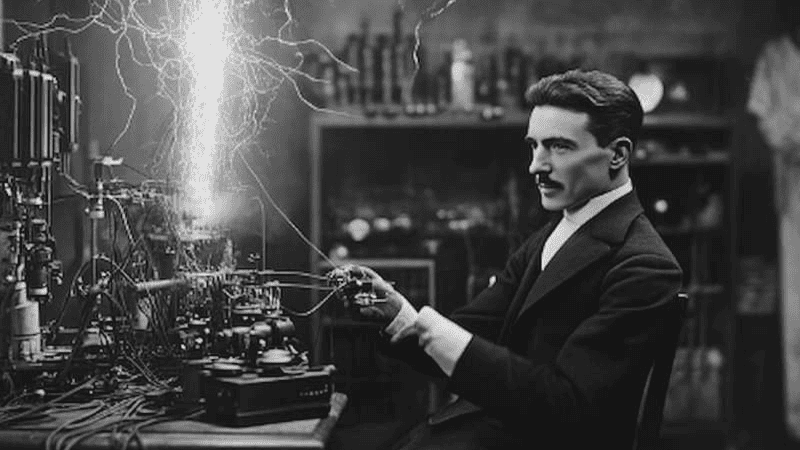
Tesla developed and promoted alternating current (AC), which allowed electricity to travel long distances. This made power generation and distribution more practical and affordable around the world.
His research on high-frequency electricity led to progress in fluorescent and neon lighting. While Tesla did not invent the light bulb, his work helped lighting systems evolve. He showcased early versions of fluorescent and neon lights at the 1893 World’s Columbian Exposition.
Tesla also invented the Tesla coil, which was key for wireless power experiments. It became important in high-voltage physics, radio technology, and neon lighting.
He played a major role in building the hydroelectric power plant at Niagara Falls. This project was a big step in using renewable energy for a large-scale power supply.
Tesla’s ideas on polyphase systems and the induction motor changed how industries used electricity. These innovations made electric power more available to homes and factories.
His vision continues to inspire today’s technology. His work laid the groundwork for wireless communication, radio, Wi-Fi, and Bluetooth.
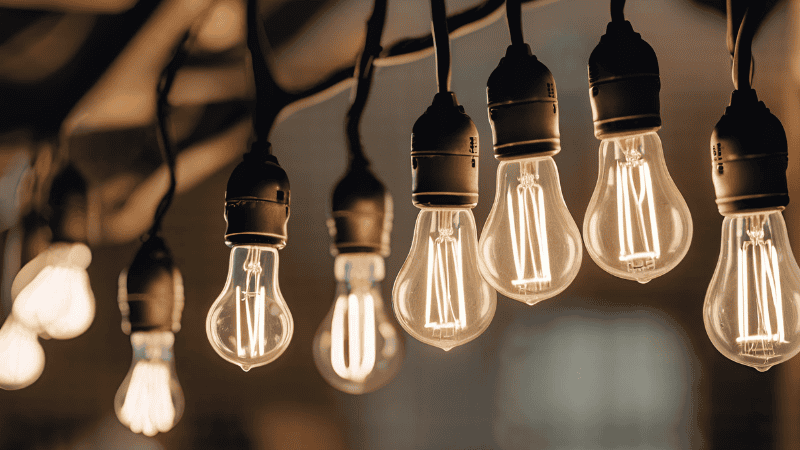
The Battle of Patents: Edison vs. Tesla
In the 19th century, Edison and Tesla entered a conflict over direct current DC and alternating current AC. When Tesla introduced his electric system, Edison spread false claims about its safety. He warned the public that it posed serious health risks and could cause deadly accidents.
Edison reinforced his claims by electrocuting animals with AC power. He used these stunts to portray the technology as dangerous. He also paid to create the first electric chair using AC power. This made people connect the technology with danger and death.
In public shows, Tesla proved his AC system was safe and efficient by letting electricity pass through his body. This helped people trust the new technology.
Soon after, AC became the top choice for future power transmission. The success of the hydroelectric plant at Niagara Falls confirms its value. It showed that AC was the best option for sending electricity over long distances.
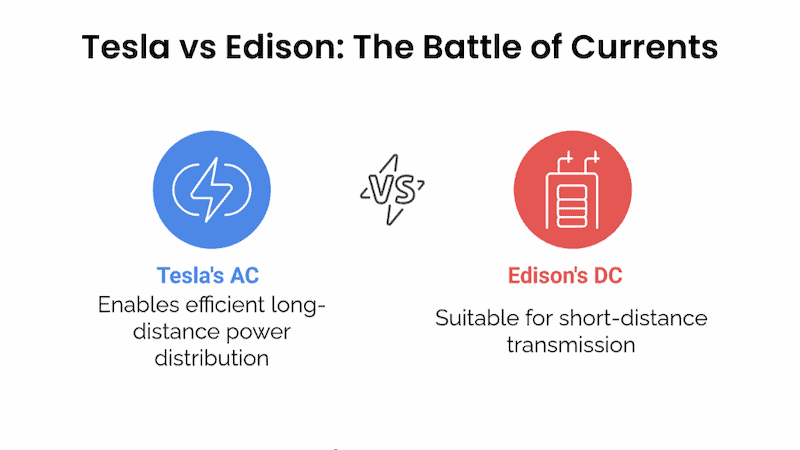
The innovation of AC power systems delivers electricity across extensive distances. Edison admitted his mistake after dismissing Tesla’s revolutionary concepts in the future. Tesla’s work laid the foundation for the electrical systems we use around the world today.
While both Edison and Tesla were brilliant inventors, their motivations set them apart. Edison focused on commercial success, building profitable systems like the incandescent light bulb and power distribution networks.
In contrast, Tesla was driven by visionary ideas. His work on AC power, wireless energy, and the Tesla coil aimed to transform how the world used electricity.
| Point of Comparison | Nikola Tesla | Thomas Edison |
|---|---|---|
| Electricity Type | Alternating Current (AC) | Direct Current (DC) |
| Approach | Scientific and visionary | Practical and business-oriented |
| Key Inventions | AC motor, Tesla coil, wireless tech | Light bulb, phonograph, motion pictures |
| Innovation Style | Theoretical, ahead of his time | Hands-on, focused on profit |
| View on Energy | Wanted free energy for all | Capitalized on inventions |
| Public Recognition | Gained fame after death | Famous and wealthy in his lifetime |
| Legacy | AC became the global standard | DC is used in limited applications today |
The Tesla Light Bulb Myth: Separating Fact from Fiction
Many people associate Nikola Tesla with the invention of the light bulb due to his work in electricity. Tesla did not invent it; Thomas Edison and earlier inventors deserve credit. Tesla’s contributions to wireless and high-frequency electricity helped develop electric discharge lamps.
He worked on artificial sunlight and electrical systems influenced modern lighting technology. Despite not inventing the light bulb, his reputation as an inventor has led many to link him to its creation.
While the public often credits Tesla, it overlooks the collaborative nature of scientific progress. His work in electrical systems and wireless power was crucial in advancing lighting and other technologies.
The Evolution of the Light Bulb: From Edison’s Incandescent to LEDs
Thomas Edison introduced practical incandescent bulbs using a carbon filament in a vacuum pump. This design made lighting affordable and reliable.
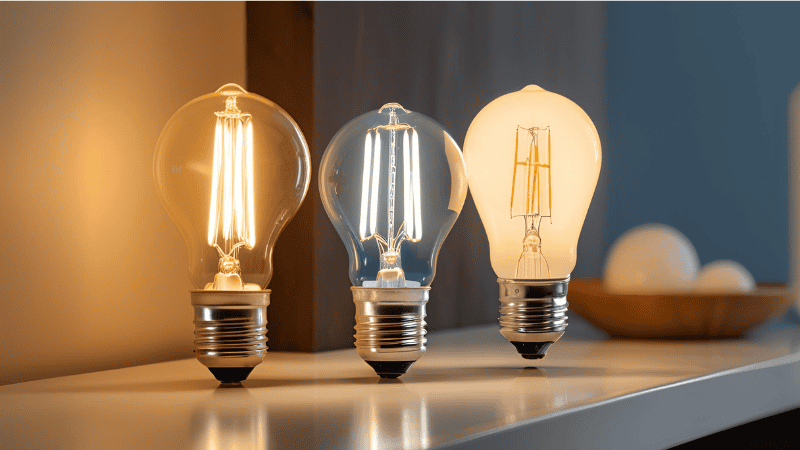
Fluorescent bulbs followed, using electricity to excite mercury vapor. The vapor produced UV light, which phosphor coatings turned into visible light.
The Halogen bulbs improved incandescent technology. They used gas-filled chambers to last longer and shine brighter. LED technology was developed in the 1960s and improved over time. LEDs have become popular because of their energy efficiency and long life.
Today, LEDs lead the market in homes and industries. The shift shows society’s push for efficient, sustainable lighting.
How Edison’s and Tesla’s Work Shaped the Industry
Thomas Edison’s successful lighting invention propelled the development of General Electric. Edison created a practical and durable light bulb that could be mass-produced. He established the Pearl Street Station, and other power stations helped distribute electricity. This made it easier for people to adopt electric lighting.
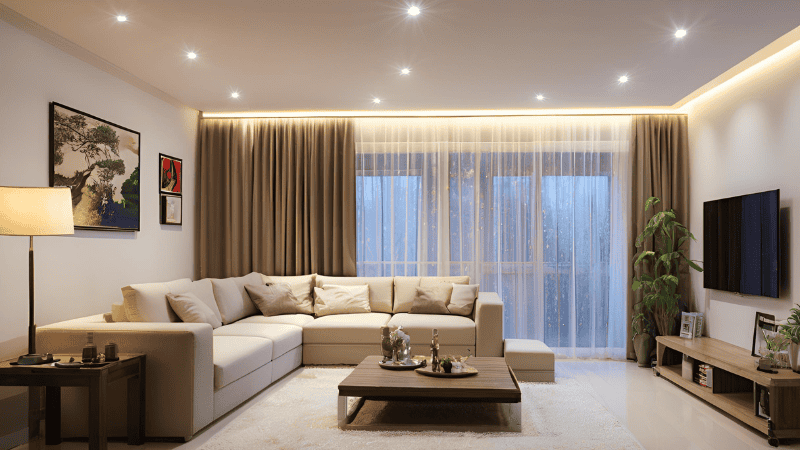
Tesla improved electricity distribution with AC systems. This makes it possible to send power over long distances. This innovation helped advance energy-efficient lighting technology. Today’s lighting industry combines Edison’s commercial success with Tesla’s groundbreaking work on electrical networks.
The Edison-Tesla rivalry highlights the need to combine innovation with commercial success. Modern manufacturers can learn to create both groundbreaking products and strong business strategies. It supports the ongoing development of systems like LED technology and wireless energy systems.
Conclusion: Understanding the True History of the Light Bulb
Understanding the light bulb’s history starts with recognizing the roles of Thomas Edison and Nikola Tesla. Edison built the commercial side of electricity, while Tesla developed AC systems. Their work laid the groundwork for modern energy-saving technology.
Today, businesses are quickly moving toward wireless power and sustainable lighting to stay ahead in a fast-changing market. Lessons from the past help guide this progress and prepare the industry for future challenges.
Transform Your Space with Energy-Efficient Lighting Solutions
Risuncorp is a leading manufacturer with over 15 years of experience in lighting and electrical solutions. We specialize in delivering high-quality, energy-efficient solutions customized to your business needs.
Our modern lighting solutions are built to illuminate the future. Explore our full range of products or contact our team to request a quote or schedule a free consultation today.
Normal light bulbs come in many shapes and sizes, with the E12 bulb being one of the most common small bases.
But what exactly is the E12 candelabra base? How does it compare to standard sizes like E26, and how can you choose the best bulb for your needs?
In this guide, you will learn everything from the precise E12 dimensions and the meaning of “candelabra base” to selecting the right E12 LED type and finding the brightest replacement options for your project.
Why are E12 Bulbs important?
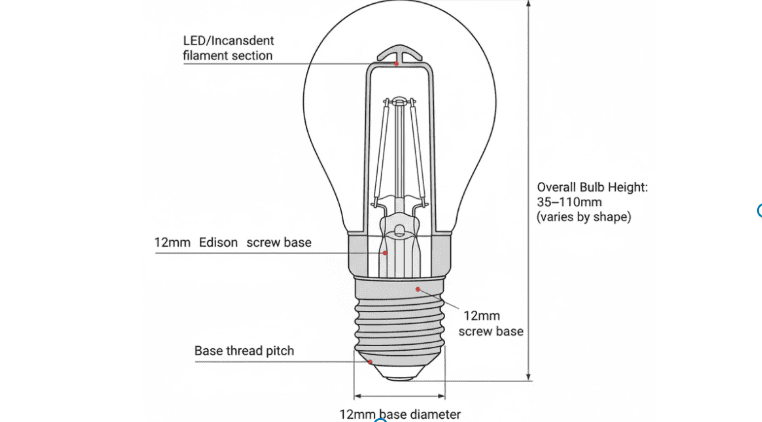
The term “E12” refers to a standardized bulb base. It helps to ensure compatibility in lighting fixtures.
Thus, manufacturers produce bulbs that can easily fit into fittings designed for E12 bases. In commercial lighting fixtures, the ready availability of E12 helps businesses achieve aesthetics, effectiveness, and compatibility.
For decor, vanity mirror lights, retail, or hospitality, E12 bulbs offer thin appearances and sufficient performance, thus constituting a first-line solution for B2B lighting requirements.
What is E12?
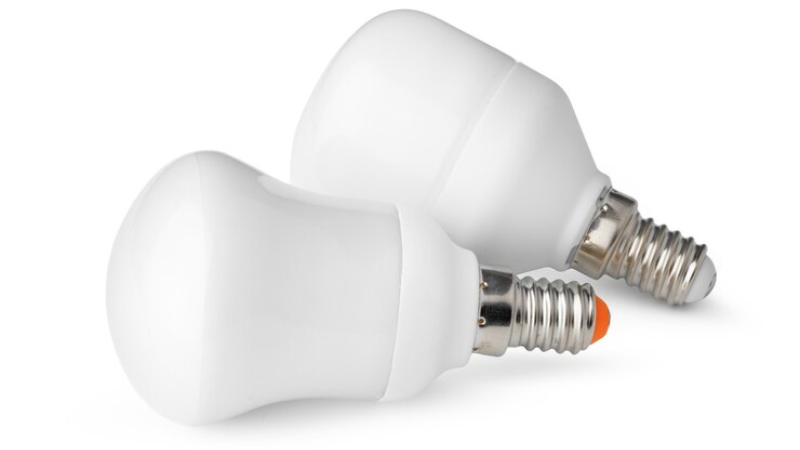
“E12” is a lighting industry-standard designation. The “E” refers to “Edison screw base,” named for Thomas Edison, who assisted in popularizing this type of base. The numeral “12” is the base diameter in millimeters — in this case, 12 mm.
E12 LED light bulbs are smaller than the common household bases, such as E26, but larger than miniature bases, such as E10. They are compact and flexible, making them ideal for miniature fixtures where style and efficiency are needed.
For companies, it is crucial to take note of this size system when selecting or replacing bulbs in the majority of uses.
E12 Bulb Size: Specifications and Sizes
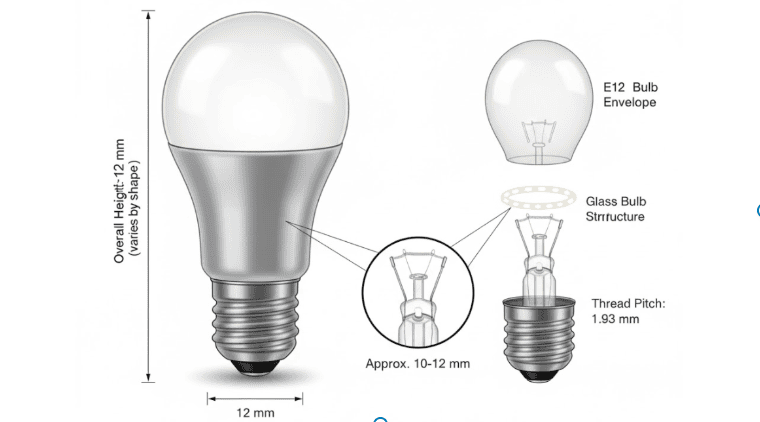
E12 LED light bulbs have a 12mm diameter candelabra base and should be installed in candelabra sockets. The bulbs are low-to-medium wattage, ranging from 15 to 60 watts for incandescent and 1 to 7 watts for LEDs.
The bulb shapes are candle-style, globe, torpedo, and flame-tip, hence giving the light fixtures a natural lighting aesthetic appeal and sophistication. The technology types under which the E12 bulb exists are LED, halogen, and fluorescent.
Companies must choose bulb type based on energy requirement, light output, light requirement, and total cost of long-term operation.
For instance, the LED E12 bulb is low in energy consumption and maintenance, which is perfect for mood lighting, decorative lights, and frequently vanity lights.
Types of E12 Bulbs: Incandescent, LED, and Beyond
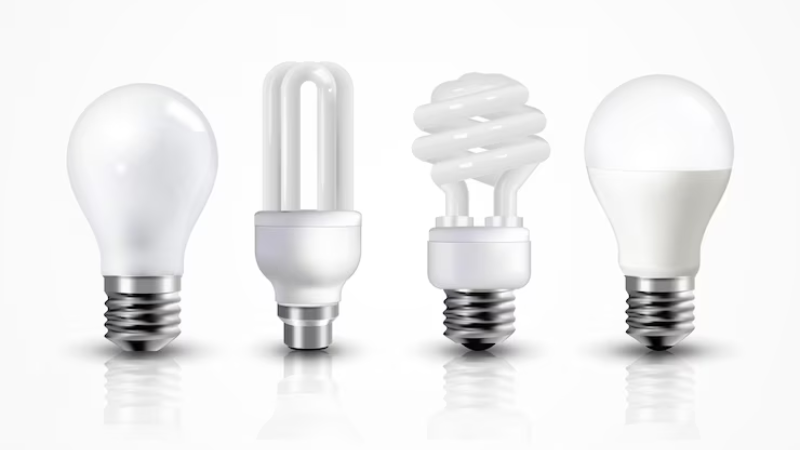
There are many E12 bulbs, each with its own strengths:
Incandescent
Cheap and retro, incandescent E12 bulbs produce warm light and are often used in retro environments. They can have shorter lifespans and higher power consumption with sufficient brightness.
LED
Energy is most efficient. LED E12 bulbs are more durable (often 15,000–25,000-hour lifespan), less power-consuming, and are available in multiple color temperatures. LED E12 bulbs are the best for business settings that need ongoing, extended-duration light sources.
Halogen and Fluorescent
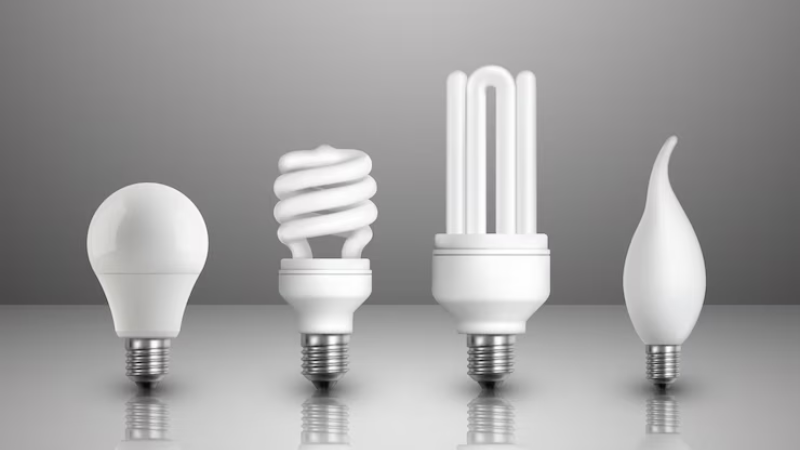
Less frequently used but yielding brighter output and some color profiles, they often find applications in specialty niches like decorative lights as a result of greater cost or regulatory constraints.
The choice is determined by the application intended, the level of energy, and the desired aesthetic impact. For companies that need to reduce energy costs without sacrificing design integrity, LED E12 bulbs are the perfect answer.
Comparing Types of E12 Bulbs
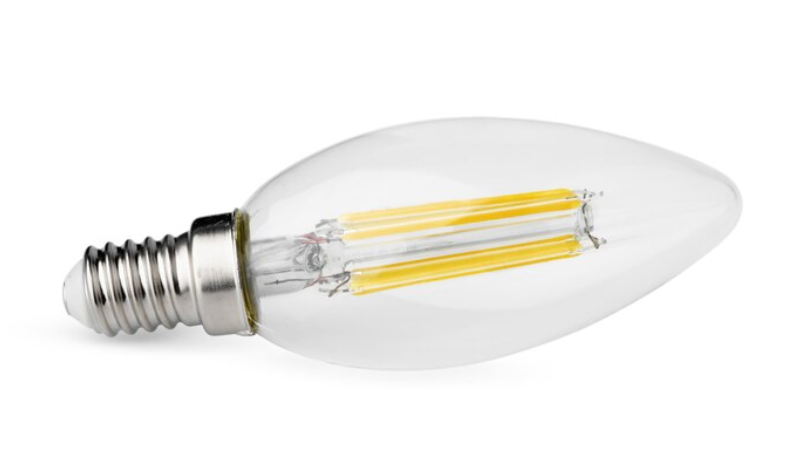
| Feature | LED | Halogen | Fluorescent |
|---|---|---|---|
| Energy Use | Very low | High | Medium |
| Lifespan | 15,000–25,000 hrs | 1,000–2,000 hrs | 7,000–15,000 hrs |
| Heat | Cool | Very hot | Warm |
| Brightness | High (adjustable) | High | Moderate |
| Startup | Instant | Instant | May flicker/delay |
| Dimmable | Yes (check type) | Yes | Sometimes |
| Mercury | No | No | Yes |
| Cost | Higher upfront | Low upfront | Moderate |
| Color Range | Wide (2700K–6500 K+) | Warm (2700–3000K) | Limited (often cool) |
E12 Bulb Applications
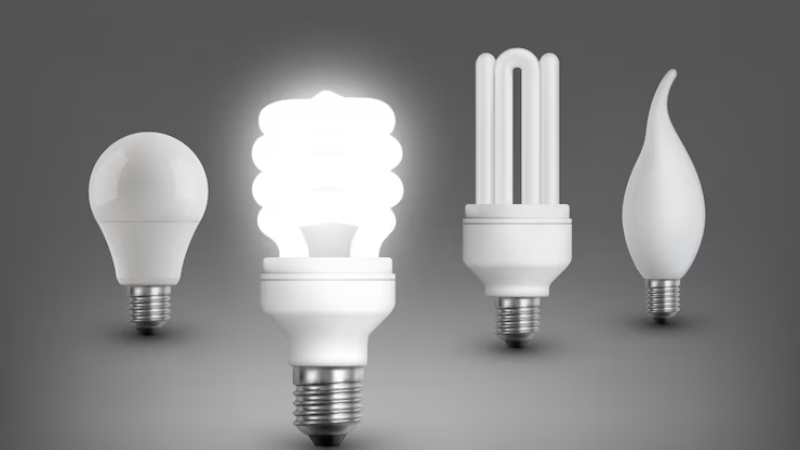
For enterprises that need massive orders of E12 bulbs, bulk purchase is economically effective as well as convenient. Building firms, event venues, and hotels purchase E12 bulbs in bulk orders like 50, 100, or more on a regular basis.
Key B2B advantages are:
- Bulk prices: Cheap unit cost on bulk purchase
- Efficient supply chains: Reliability of supply and quicker replenishment by well-established distributors
- Customization features: Option to select wattage, form, or LED dimming depending on project requirements
- Energy efficiency: LED E12 bulbs significantly lower energy usage, and customers save money on their utility bills
- Extended maintenance: B2B deals have warranty maintenance, logistics coordination, and customer support
Businesses buying E12 bulbs must be watchful to involve sellers who have reasonable prices, guaranteed quality, and flexible delivery options. This guarantees that lighting demands are fulfilled without disruptions, particularly in image-sensitive or traffic-prone environments
How to Choose the Best E12 Bulb
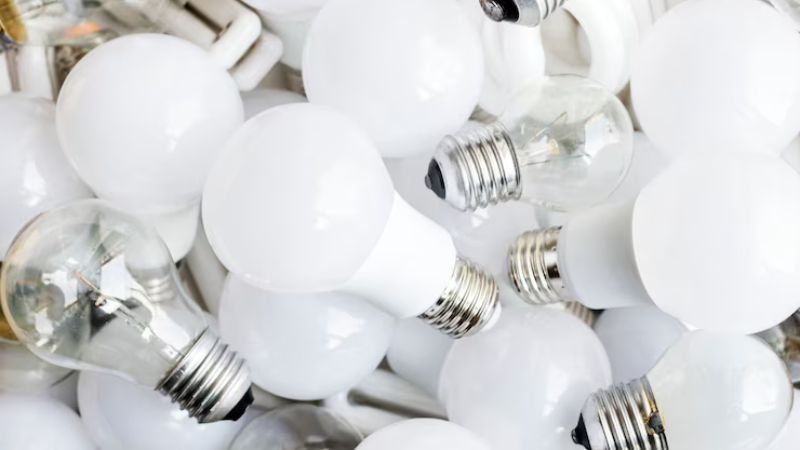
Choosing the right E12 bulb for your business is the most critical step to achieving that ideal light effect, keeping in mind energy efficiency and affordability. The first thing you need to do is think about what you’re going to use the bulbs for.
Are you going to utilize them as a decoration on a chandelier or as a do-it-all night light in an all-around small pendant lighting system? The purpose you have in mind that the bulb will serve in your environment will be your determining factor.
1. Key Factors To Consider
When selecting the appropriate E12 bulb, consider wattage, bulb shape, and color temperature. Wattage controls light. Lower watts work best for decoration, and higher watts work best for task lighting and for a better power supply.
Bulb size, like the globe or candle, determines what the fixture looks like and how light is distributed. Color temperature also affects mood. Warm color gives a warm, cozy ambiance, while cool color offers bright, neutral light.
Efficiency with energy consumption is last but foremost, particularly for businesses. LED E12 bulbs consume less energy and have a longer lifespan, making them a great option for budget-conscious businesses.
2. Step-by-Step Guide for Choosing E12 Bulbs
Step 1: Determine Purpose and Aesthetics
- For Aesthetic Fixtures (e.g., chandeliers): Employ low-wattage bulbs with elegant shapes, such as candle or flame-tip designs, to complement the fixture’s look.
- For Utilitarian Lighting: Choose slightly higher wattage and utilize LED bulbs for superior resilience and energy efficiency.
Step 2: Balance Performance and Efficiency
- Prioritize LEDs: For commercial establishments or high-use areas, always opt for LED bulbs. The long-term cost advantage from reduced maintenance makes them the ideal choice.
- Match Performance and Shape: Ensure you select the correct watt-to-lumen ratio and bulb shape to meet the aesthetic look and required light quantity for the space.
- Mind Energy Usage: Always keep overall energy consumption in mind when determining the final wattage, especially in large installations.
E12 Bulb Problems in Usage Solutions
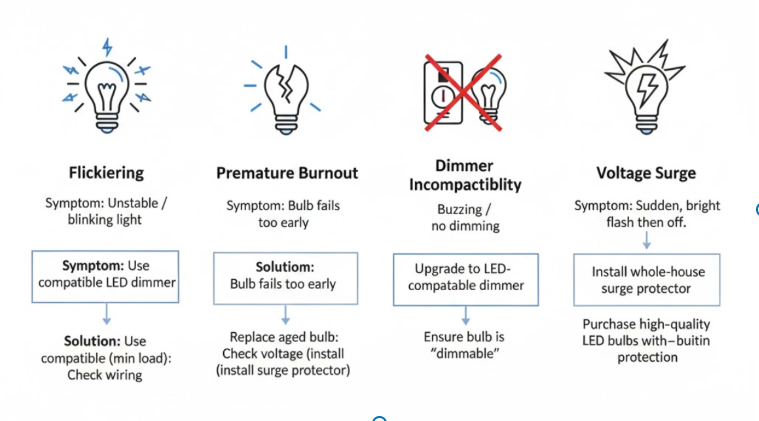
Though E12 bulbs are commonly used for commercial purposes, there are some issues that are likely to occur with them after a while. Flickering is one of them, and it may be due to an incompatible dimmer switch or an old bulb nearing the end of its life. There may be some other reasons the light flickers.
Replacing the bulb or fitting an incompatible dimmer switch can correct this issue. Another concern is bulb burnout caused by power surges or cheap bulbs.
Purchasing bulbs from a quality supplier can eliminate frequent burnout. In case you use incandescent bulbs, it may be advisable to change to LED E12 bulbs for durability.
Conclusion
E12 bulbs are a convenient and multi-purpose lighting option for most business settings. From lighting fixtures in a hotel lobby to creating ambiance in a retail setting, E12 bulbs offer the best of style, efficiency, and performance.
With incandescent, LED, and other lighting options, businesses can adjust their lighting requirements to suit their budget and operational aspirations.
Collaborate With Risuncorp for Quality E12 Bulbs and More
At Risuncorp, we stock an incredibly large variety of E12 bulbs, including energy-efficient LED bulbs, to illuminate your company as needed.
Get in touch with us now and learn about bulk purchases and how we can illuminate your company with functional, enduring products.
FAQs
Q1: How do E12 and E26 bulbs vary?
E12 bulbs have a base of 12mm, and E26 bulbs have a base of 26mm. E12 bulbs are used in mini fixtures, such as chandeliers, and E26 bulbs in regular lighting.
Q2: Can all light fixtures install E12 bulbs?
E12 bulbs can be installed in the fixtures that are compatible with a 12mm base, such as pendant lights and chandeliers, but not in large ones designed for E26 bulbs.
Q3: How much longer do LED bulbs last compared to incandescent?
LED E12 bulbs last 15,000–25,000 hours, much longer than incandescent bulbs, which last around 1,000–2,000 hours.
Q4: Are E12 bulbs dimmable?
Most E12 bulbs are dimmable, especially LEDs, but if you use a compatible dimmer, you can get better results. Use LED E12 bulbs with compatible dimmer switches for optimal use.
Theater lighting serves a far more specific function than light sources themselves—it creates atmosphere, pinning attention, and gives emotional significance to a performance.
In modern stage lighting design, every beam, color, and shadow plays a storytelling role. Whether you’re using traditional theatre lights or advanced LED stage lights, each lighting type helps shape the visual rhythm of a performance.
Lighting Sellers today take leading roles in this type of work, using color, position, and amount of light to re-read the script and project the director’s intent onto the stage.
The 3 Functions of Light in Theatre Productions
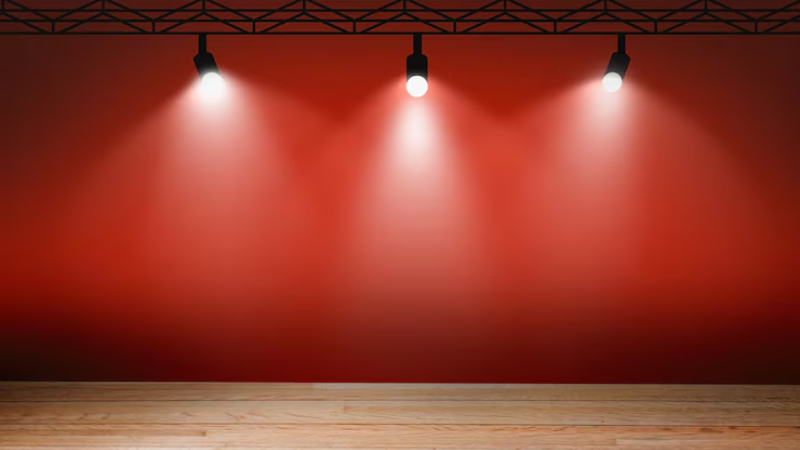
Theatrical lighting is not just needed to avoid invisibility but also to narrate and visualise the stage lighting design and emotional perceptions for the audience.
Creating and Building Atmosphere
Stage lighting fixtures play a monolithic role in establishing a mood for a scene. With careful control of intense light quantity, correct bulb size, shape, code, and color of light, lighting will subsequently be able to create warmth, isolation, tension, or ecstasy.
Cold blues will typically be used in an attempt to instil sadness or calm, and fire red and oranges will heighten tension or want. This type of stage lighting is known as “mood lighting,” a key aspect of theatrical lighting design that manipulates emotional perception.
These are consciously regulated in the desire to play upon the audience’s feelings and draw them into the tale.
Directing Audience Attention
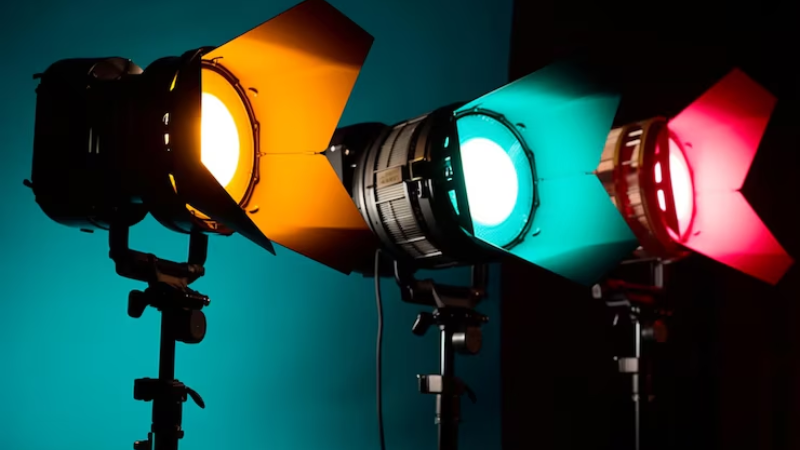
Stage lighting is the strongest attention-directing device. Through the placement of a parabolic aluminized reflector on an actor or object, designers are able to create meaning and allow viewers to see through intricate scenes.
This method, known in stage lighting as “focus lighting,” uses various fixtures—such as ellipsoidal spotlights, Fresnel lamps, and floodlights—to precisely direct the audience’s gaze.
The Art of Stage Lighting: Depth, Emotion, and Technique
Creating Dimension and Emotion
Light is the crucial element that adds physical and emotional depth to stage imagery. Designers use techniques like shadowing, contrasting light, and dark areas to replicate three-dimensionality, transforming flat scenes into layered, kinetic images.
Modern lighting is essential for amplifying emotional impact; for instance, LED strip lights are now frequently used to add subtle depth and highlight the character’s emotions more accurately than traditional sources.
Essential Fixture Types and Their Roles
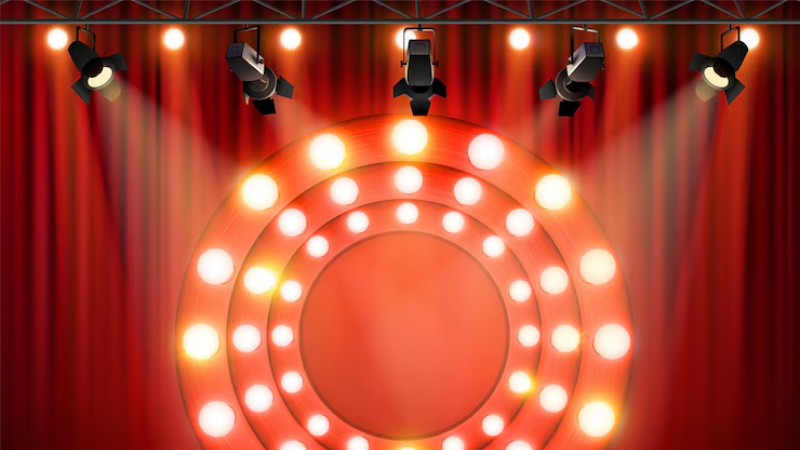
Modern stage design commonly incorporates new technologies for realism and drama:
1. LED Strip Lights and Moving Head Lights
These fixtures are ubiquitous in contemporary theatre, significantly enhancing mood and depth, particularly in dynamic musical and dance productions.
2. Side Lights and Up Lighting
Side lights are vital for defining the lines of performers and scenery, using lateral light to reveal depth and dimension.
Up lighting, typically positioned near the base of walls or objects, is used to highlight dramatic shadows and enhance architectural features.
3. Spotlights
These fixtures are used to pinpoint primary areas or characters, focusing the audience’s attention where the narrative requires it most.
The Power of Custom Design
A successful scenic design is the result of multiple elements—including colored lights, custom designs, and highlighting—working in cooperation.
- Individual Stage Lighting Design must adapt every element to satisfy the production’s mood, theme, or storyline, ensuring visual cohesion and aesthetic effect.
- Overall Impact: Collectively, these varied lighting modes create a smaller, tighter, and more visually intense plane that effectively serves the story and powerfully instills the desired atmosphere.
The 6 Types of Theatre Lights and Their Uses
The diverse range of lighting used in theater has specific functions but collectively comprises the visual and emotional landscape of a production and facilitates visibility, definition, and authority of theater in the performance area.
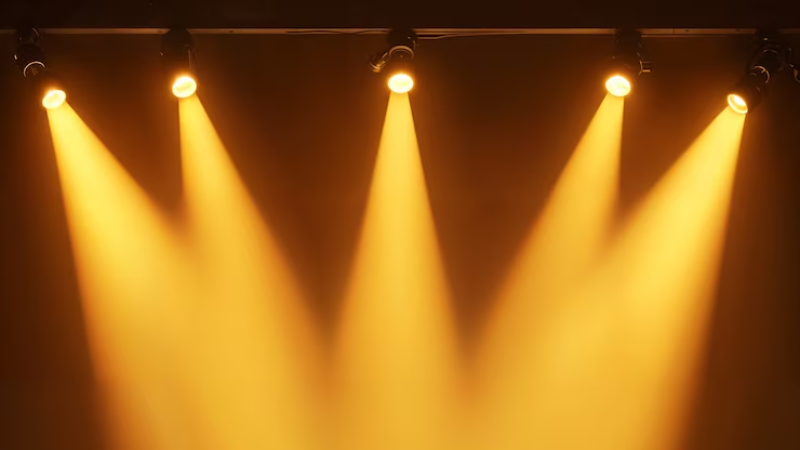
1. Spotlights
Spotlights are conventional dramatic beams that light up individual actors or sections of the stage. These are separate from “foodlight,” which tracks actors moving across the stage. So, select spotlight vs floodlight with careful consideration.
Ellipsoidal Reflector Spotlights (ERS) are used to create a focused beam of light, and they are best suited for use in situations where precision and control are required.
They are generally applied in stage and theatre productions where sharp edges, well-defined lighting areas, and accurate focus are required.
Their ability to concentrate and throw light so finely enables lighting designers to outline high-intensity highlights on precise performers, props, or areas of a set with little spill.
In return, Fresnel Spotlights create a diffused, soft beam with angular spread and limited beam adjustability.
Although they do not have the pinpoint accuracy of ERS, their broader coverage renders them ideal for general lighting, lighting broad swaths of the stage, or producing ambient light effects.
When employed as backup fixtures in commercial lighting rings, both spotlights make up for the shortcomings of the other.
2. Wash Lights
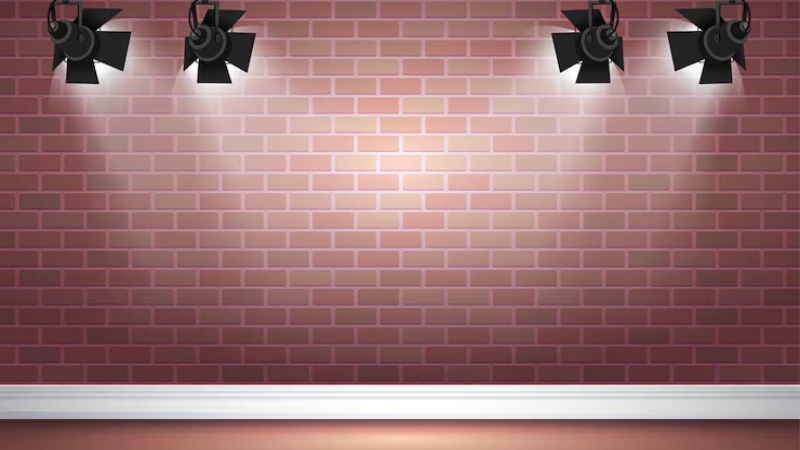
Wash lights illuminate enormous stage areas evenly. PAR Can Lights provide steady, brilliant light but limited flexibility. Floodlights are available only with electronic control.
Floodlights are used to light large stage areas evenly, and they look across wide angles. Floodlights are also used in outdoor spaces to create a secure and comfortable environment.
Coordinating lighting systems in colour and brightness helps meet various scene needs. It also preserves visual harmony. This method enables steady illumination that aligns with the atmosphere or activity of a scene without overwhelming the focal point.
Designers can create a subtle mood by using equally low lighting in the background and crowd areas. This approach keeps the focus on the main performance without distraction.
Using controlled, even lighting in these spaces ties the visual design together. It makes sure all stage elements support the intended mood and story.
This method works best for complex productions. Background scenery and secondary actors help to create the setting.
3. Backlighting
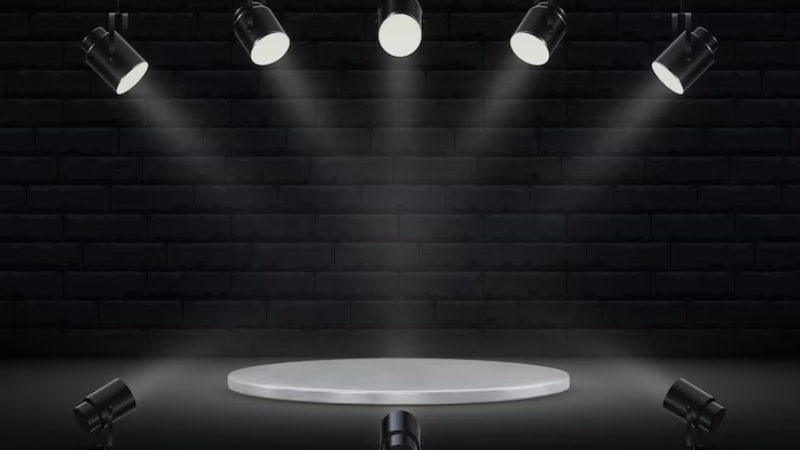
Backlighting is a great technique for stage lighting. It adds depth, dimension, and appeal to a performance. When light shines from behind the performers, it creates dramatic silhouettes. This separates them from the background and boosts their visibility and interest.
This separation allows the audience to focus on the performers and their awareness of the stage. Backlighting works well for creating drama. It often sets the mood in scenes with suspense, mystery, or fantasy.
In suspenseful scenes, it creates a spooky atmosphere. In fantasy dramas, it brings a sense of magic. Used subtly or boldly, backlighting defines the emotional tone and visual story of a stage play.
4. Footlights
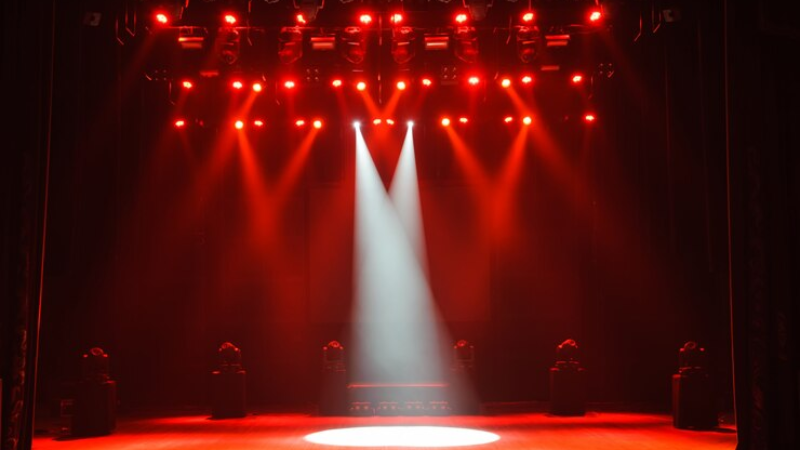
Footlights or downlights avoid unpleasant facial shadows by adjusting the beam shape. While footlights originated in classical theatre and can seem antiquated regarding present-day lighting norms, they remain functionally and aesthetically relevant today in stage production.
They existed from the beginnings of theatre lighting, when they were among the major sources of light, put at the stage front to illuminate actors from beneath. Footlights are selectively utilized nowadays in style or period pieces to create a sense of realism and maintain the historical integrity of the environment.
Footlights not only hold nostalgic value but also provide soft, upward lighting. This creates a warm ambiance that pairs well with other lighting effects.
This old method of lighting design can effectively show the style and character of a setting. So, footlights are an important tool for some uses in the theatre.
5. Moving Lights
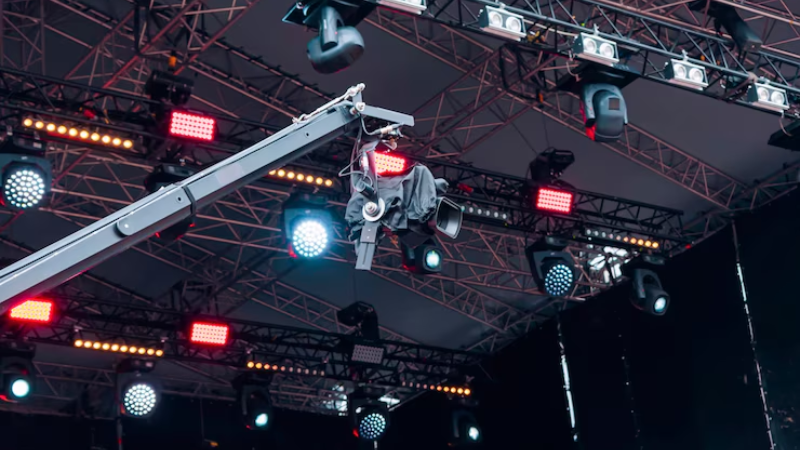
These smart lights can be adjusted in direction, colour, and beam angle when in use. Choosing the right beam angle is very important in moving lights.
DMX is controllable, with dynamic beam control and effect, i.e., Gobo projectors. Highly flexible, they are particularly used for dance, concert, and high-energy shows.
6. Special Effects Lighting
Special effects lighting creates striking visual scenes. It includes strobes, UV light, lightning effects, RGB lighting, and smoke sets.
When used with colour gels and Gobos, modern lighting boosts storytelling in visual or supernatural forms.
Metal or glass Gobos sit in front of a light source to cast detailed designs or patterns on stage. They add textures like windows, leaves, or magical symbols. Colour gels help set the mood by adding rich colours that reflect the emotions of a scene.
These tools let lighting designers create immersive spaces that support the story. Whether it’s the eerie light of an alien forest, the glowing charm of a fantasy world, or the sharp contrast in a high-fantasy duel, they are vital.
With their power to shape mood and visual impact, these lighting effects draw viewers deeper into the narrative.
Comparing Different Theatre Lights
| Light Type | Beam | Use Case | Color Ctrl | Cost |
|---|---|---|---|---|
| Spotlights | Narrow | Focus actor | Manual | Medium |
| Floodlights | Wide | Background | Limited | Low |
| PAR Cans | Fixed | Wash areas | Gel-based | Low |
| Fresnels | Soft edge | Area light | Manual | Medium |
| Ellipsoidals | Sharp | Front light | High | High |
| Moving Heads | Variable | Effects | Digital | High |
| LED Fixtures | Custom | All-round | Full RGB | Medium |
The Role and Impact of the Lighting Designer
Lighting designers are crucial in shaping a theatre production’s visual and emotional tone. Their work is a sophisticated blend of art and technical expertise.
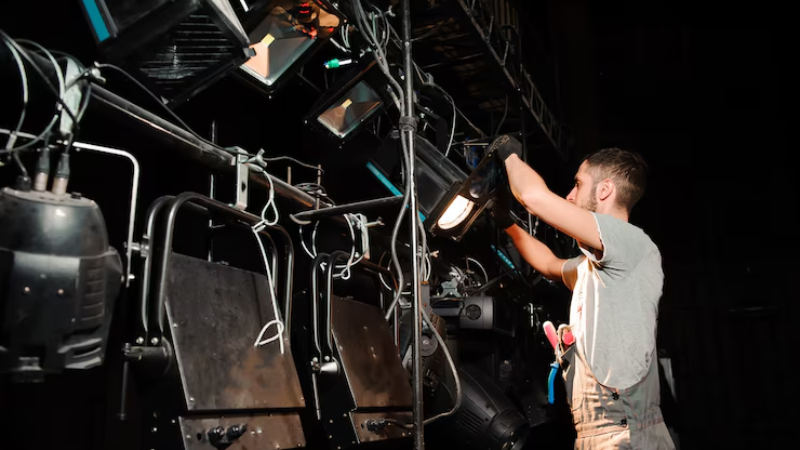
Lighting designers are crucial in shaping a theatre production’s visual and emotional tone, blending artistic vision with technical expertise.
Their core responsibilities involve:
- Interpreting the Script: Reading the narrative to match lighting schemes to the mood, adjusting brightness per scene, and selecting appropriate fixtures.
- Guiding the Audience: Using expert control over color, brightness, direction, and timing to strategically place lights and guide the viewer’s gaze, thereby developing the story on stage.
- Technical Synchronization: Collaborating closely with light technicians to ensure equipment installation and programming follow the design. Crucially, they sync lighting cues precisely with performers’ movements during rehearsals.
A designer’s keen eye ensures a visually cohesive and smooth performance, with their work greatly enhancing the overall professionalism and effect of a stage show.
New Stage Lighting Equipment and Technology
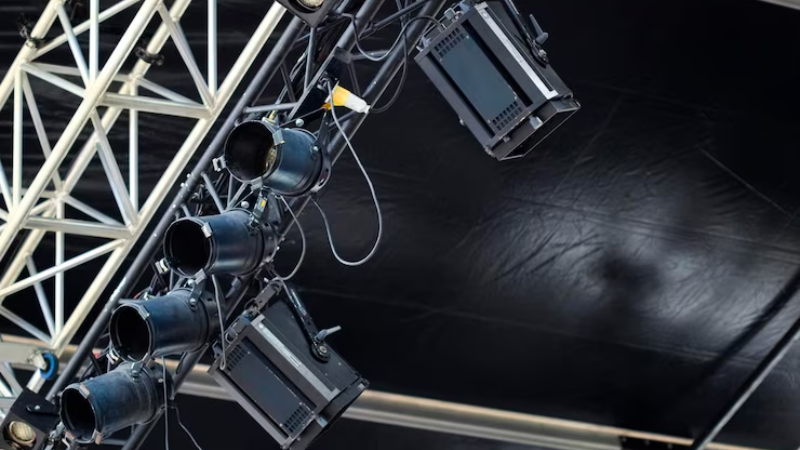
The technology of lighting in theatre has improved significantly thanks to high-tech developments. It now offers better accuracy, better color rendering index, flexibility, and cost efficiency.
Older systems had issues with colour rendering, light quality, and controls. Now, many have been swapped out for smart LED lights and electronic systems. This shift allows for amazing creative freedom.
LED lighting is now the standard in stage lighting. It is energy efficient, produces low heat, and lasts longer. They have set the stage for the latest technologies to be used in theaters.
These lights create unique colour palettes without gels. This allows for quick and uniform scene changes. Program-controlled and motorised lights can change position, shape, colour, and brightness in seconds. They help to enhance the performance on the stage.
The heart of these systems is DMX (Digital Multiplex) technology. This lets designers and technicians control many fixtures from one console. They can sync with actors’ movements, visuals, and sound to create a more rewarding experience.
Hybrid Lighting Systems

The hybrid lighting system combines smart LED lighting for great versatility.
Light designers use various methods to blend these systems. They consider the warm colour of incandescent spotlights and the dynamic control and colour movement of moving head LEDs.
Hybrid systems effectively display complex light effects, like rain or sunset. They also add multimedia elements, like projections or interactive graphics. This keeps the artistic flow smooth between different parts of the performance.
Conclusion
Light is what makes an outstanding theatre performance. Light is used to tell a story, give a show its visual rhythm, and bring us together. With the help of new technologies, lighting designs are improving day by day. Achieving the correct light and using it can turn a mediocre show into a legend.
Partner with Risuncorp for Premier Theatre Lighting Solutions
Partner with Risuncorp to get the latest theatre lighting inventory. Explore our full product lineup and discover how we can help bring every scene alive to new heights.
Contact our team today to discuss custom lighting solutions for your event or venue.
Choosing the right ceiling fan color is a bigger deal than you might think. It’s not just about a fan’s function; it’s a key design decision that can totally change the vibe of your room. The right color can tie everything together beautifully, while the wrong one can feel completely out of place.
This guide will walk you through picking the perfect color for your space, helping you make a choice you’ll love for years to come.
Why Ceiling Fan Color Matters?
A ceiling fan‘s color has a powerful impact on your room’s design. It’s a functional fixture, of course, but think of it as a design element that can either enhance your space or clash with it. The right color creates a balanced look and helps you get the exact mood you’re going for.
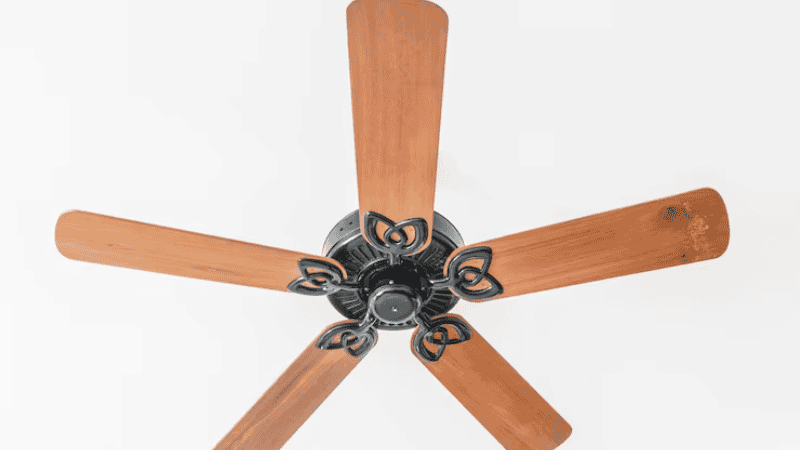
- To Make Your Room Feel Bigger: Want your space to feel more open and airy? Go with lighter colors like white or brushed nickel.
- To Create a Cozy Vibe: If you’re aiming for a warm, cozy feel, darker colors like bronze or wood finishes are your best bet.
- For a Cohesive Look: Matching your fan to your furniture or walls creates a seamless, put-together look.
- To Make a Statement: If you want your fan to be a showstopper, a contrasting color can become a bold focal point and really show off your personality.
What are the Most Popular Ceiling Fan Colors and Why?
There are some colors of ceiling fans that are never out of fashion because they are stylistically very adaptable and can mesh with any interior. Here are the most popularly chosen ceiling fan colors and why they are so well-liked:
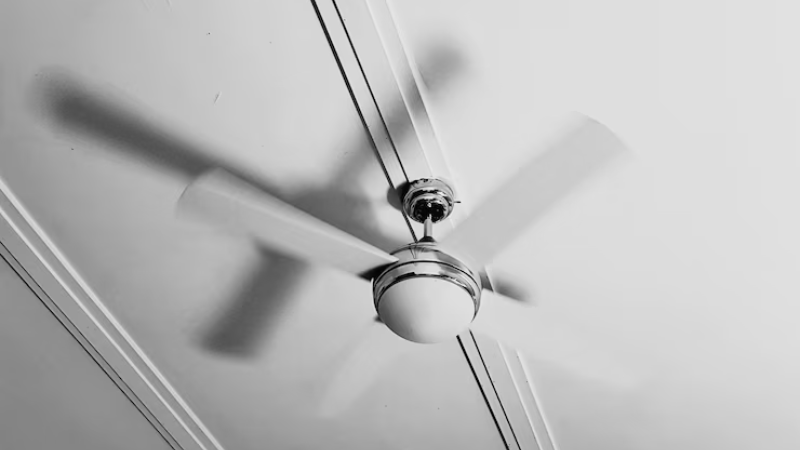
White Ceiling Fans
White ceiling fans are a timeless classic for a reason. They have this amazing ability to just blend in, especially if your ceiling is white or a light color.
This creates a clean, minimalist look that makes your room feel more open and spacious.
They’re the perfect choice when you’re going for a light, airy vibe, and you’ll find them everywhere from traditional to modern coastal homes.
Black Ceiling Fans
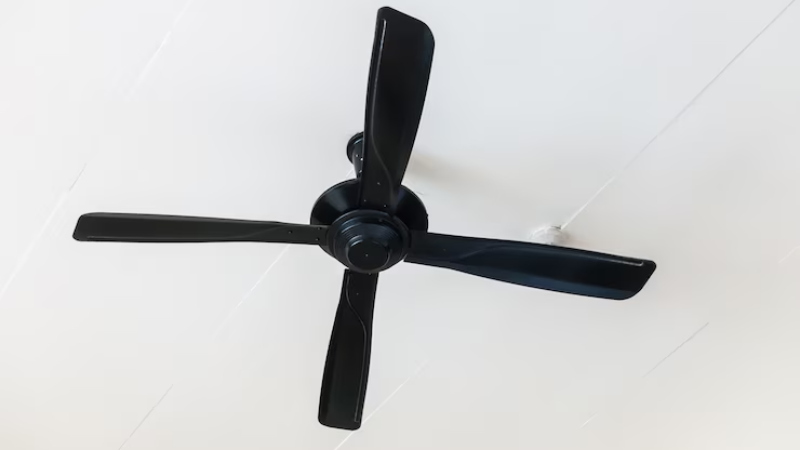
Black ceiling fans have exploded in popularity for their bold, sleek, and modern appeal. They’re a dramatic focal point, creating a sharp contrast against light walls or ceilings in your home.
This strong visual anchor adds an instant touch of sophistication and depth.
Black fans are a perfect fit for modern, industrial, and minimalist styles, working beautifully in urban lofts, home offices, or any room with a neutral color palette.
Bronze and Oil-Rubbed Bronze Ceiling Fans
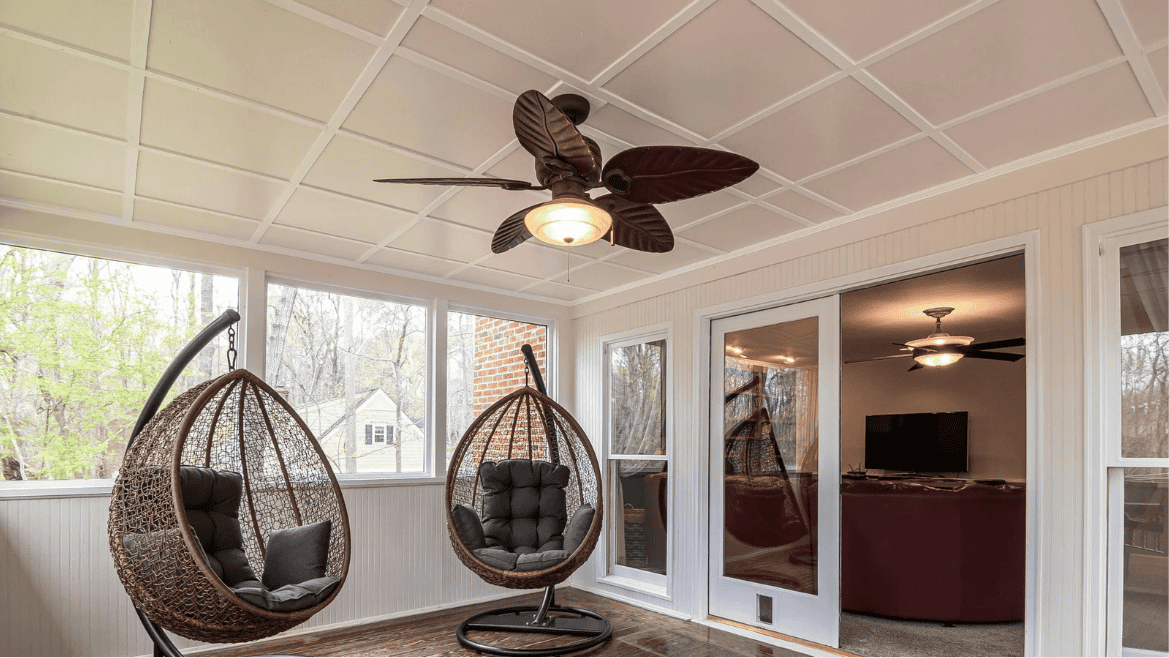
Brushed nickel and other metallic finishes are a must-have for modern and transitional interiors. These sleek colors add an instant upgrade that pairs beautifully with your stainless steel appliances, minimalist furniture, and other metallic accents.
- Brushed Nickel has a soft, matte look that works perfectly in contemporary spaces.
- Chrome gives you a high-shine, mirror-like finish for a bolder, dramatic modern look.
- Bronze is a warmer, deeper metallic tone that adds a touch of classic charm to your transitional spaces.
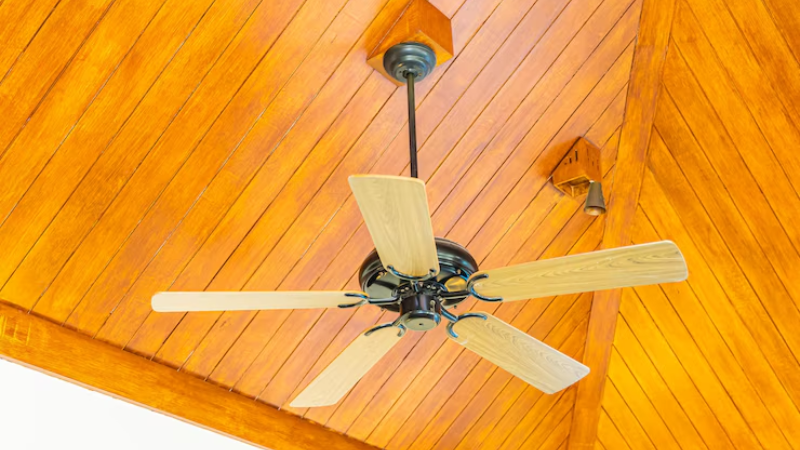
Wood-Finish Ceiling Fans
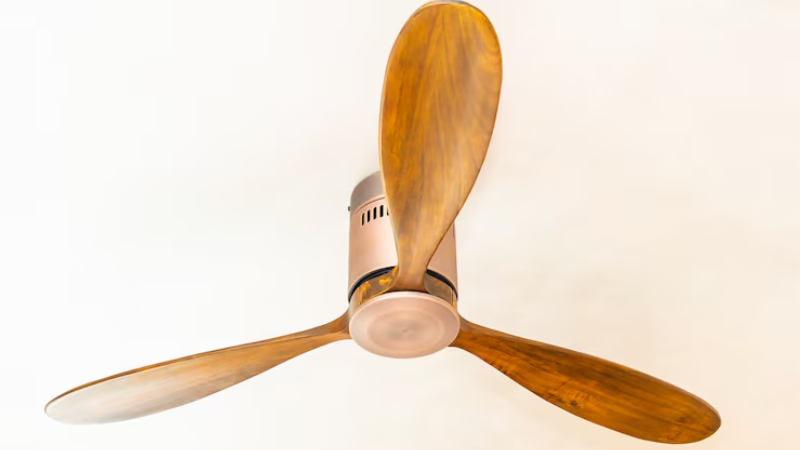
Wood-finish ceiling fans, from light pine to dark walnut, bring a touch of natural warmth and texture to any room.
They’re incredibly versatile and work beautifully with farmhouse, Scandinavian, boho, and tropical styles. These natural tones add a cozy, grounded feel and effortlessly complement your other wood furniture or light color palettes.
Why are Black Ceiling Fans Sleek, Bold, and Modern?
Black ceiling fans are among the best choices for modern, industrial, and minimalist house designs because they have strong visual appeal and adaptive styling. Their deep, strong color naturally tends to attract attention, so they’re a dramatic focal point wherever they’re used.
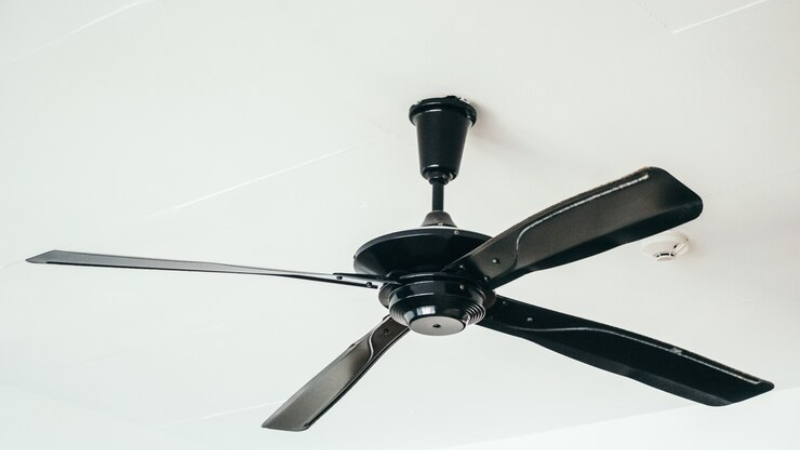
Black fans provide a clean contrast to light walls and ceilings, which provides sophistication and depth to the room. They are ideally suited to rooms with metallic trim, exposed brick, or a neutral color scheme, and add sophistication without overtaking the aesthetic.
If the setting is an urban loft, fancy office space, or monochrome living space, black ceiling fans offer a high-end and sophisticated look without compromising their functionality.
How Can White Ceiling Fans Complement Any Room Style
White ceiling fans continue to be an evergreen hit because of their subtle simplicity, versatility, and capacity to suit the overall look of any given room. They can easily harmonize with almost all ceiling shades so that they become invisible yet perform an essential role.
Why White Ceiling Fans Never Go Out of Style
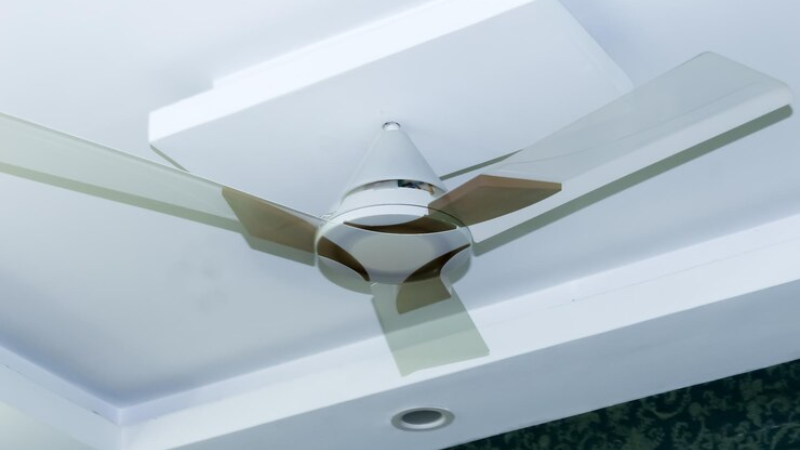
White ceiling fans offer a clean, unbroken ceiling line, and this contributes to a light, airy atmosphere through spatial continuity.
Because they can be turned off, they will not clash with the color of the wall or furniture, and thus are a safe, stylish addition to traditional and contemporary rooms.
Best Rooms for White Ceiling Fans
Due to their versatility, white ceiling fans can be used in almost any room in the house. They are particularly favored in bedrooms, kitchens, and beach-inspired living rooms, where their light and airy look makes the room appear bigger and more serene.
Regardless of whether your aesthetic is minimalist, farmhouse, or transitional, a white fan harmonizes beautifully with it, adding a warm touch to the overall decor.
Brushed Nickel and Metallic Finishes
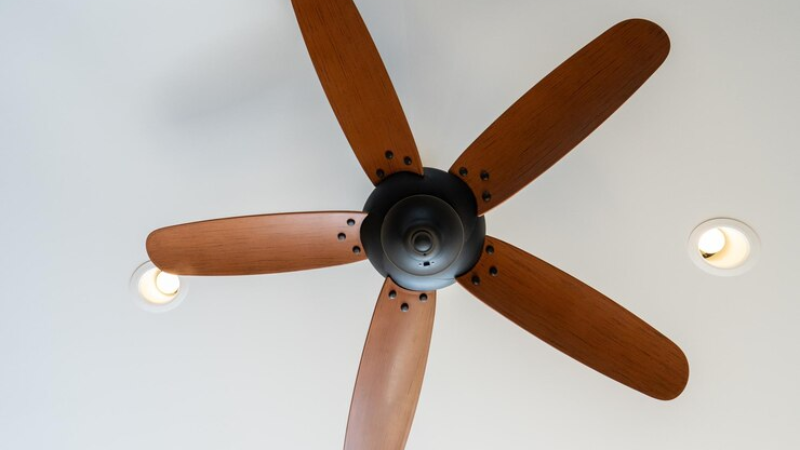
Brushed nickel, chrome, and bronze finishes are currently all the rage for contemporary and transitional interior spaces. They provide a clean, smooth appearance that adds an upscale touch that works well with the clean lines and minimalist look of contemporary spaces.
Brushed Nickel vs. Chrome vs. Bronze
Brushed nickel blades offer a muted, matte appearance that will complement neutral and unobtrusive spaces. Chrome enthusiasts, with their mirror sheen, give a more dramatic, modern appearance, perfect for offering a strong accent.
Bronze is deeper and warmer in tone and works well in transitional spaces where sophistication combines with a pinch of old-world taste.
Both of these finishes also complement other metals in a room, such as lighting, cabinet hardware, and appliances, so it is simple to choose a uniform and stylish design scheme.
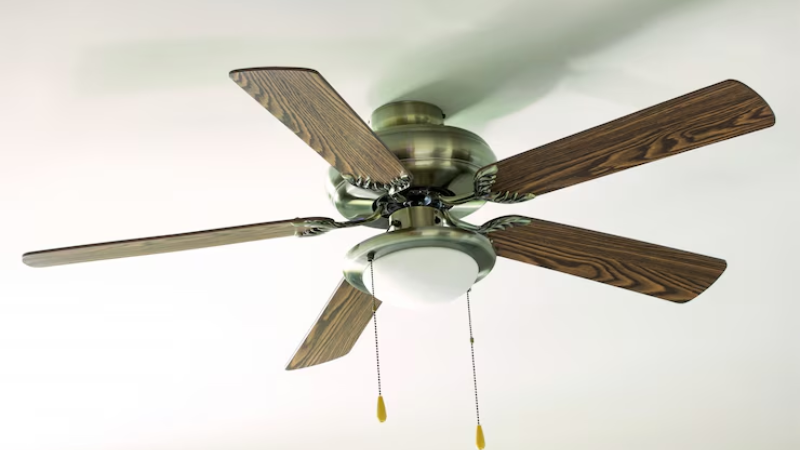
Are Wood-Tone Ceiling Fans the Best Choice?
Wood-grained ceiling fans bring warmth, texture, and a feeling of grounding from nature to an area, which is why they are especially well-suited for natural and cozy interior decor styles. Their natural finish easily blends with natural accents and domesticates contemporary corners.
Comparing Different Colors Of Ceiling Fans
| Color | Style | Best For | Vibe |
|---|---|---|---|
| White | Clean, Minimal | Modern, Coastal Rooms | Airy, Fresh |
| Black | Bold, Sleek | Industrial, Urban | Dramatic, Strong |
| Brushed Nickel | Modern, Neutral | Contemporary spaces | Cool, Refined |
| Wood Finish | Warm, Natural | Rustic, Boho | Cozy, Earthy |
| Bronze | Classic, Elegant | Traditional interiors | Rich, Timeless |
| Matte Grey | Subtle, Chic | Modern, Loft-style | Calm, Understated |
How to Select the Perfect Ceiling Fan Color for Your Room
Choosing the right ceiling fan color is a key step in finishing the room’s overall décor. Several important points must be considered, including the sense of existing decor, size of the room, height of the ceiling, lighting, and flooring.
You have to decide whether the ceiling fan is going to be hidden or highlighted.
In parallel with color coordinating fan color to wall paint, furniture, and floor, you can create a monotonous appearance, but contrasting colors create an aesthetically beautiful appearance and the aesthetic of a room.
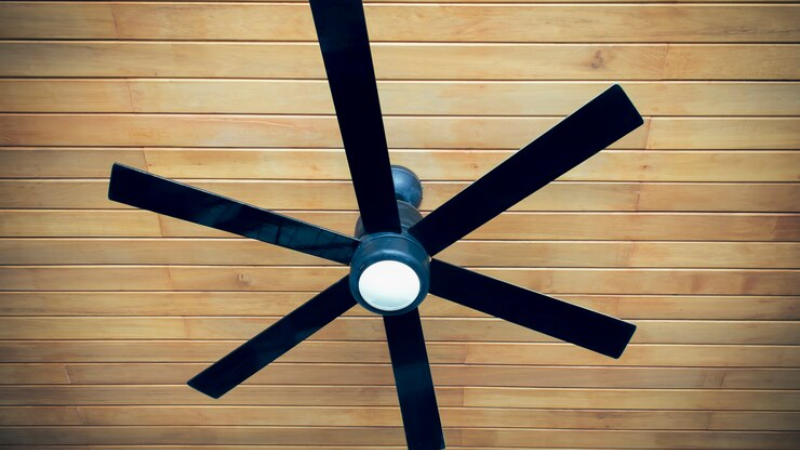
1. How to Match Furniture and Flooring
The best way to create a cohesive look is to match your ceiling fan’s color with your existing furniture and flooring.
- For Dark Furniture: Choose dark wood or bronze fans to add richness and sophistication.
- For Natural Materials: A wood-finish fan is a perfect match for rooms with hardwood floors, wooden beams, or handcrafted furniture, creating a sense of natural continuity.
2. How Do You Pick the Proper Ceiling Fan Color
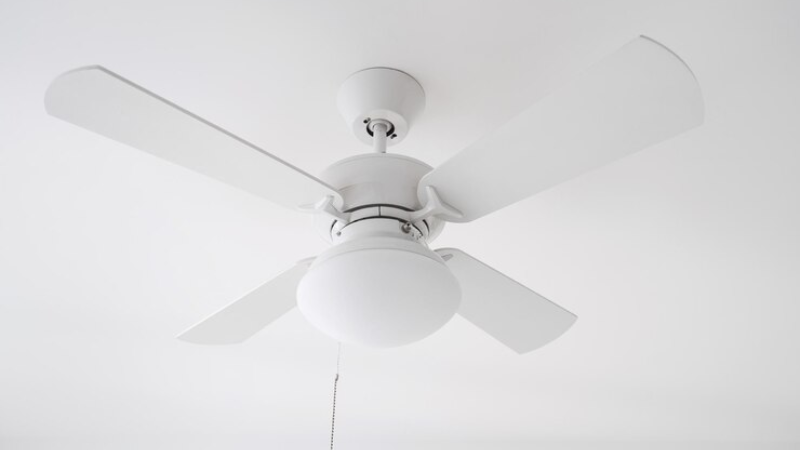
A fan that matches the ceiling color creates a seamless, minimalist look. This is especially effective in smaller rooms, as the fan will blend in and make the space feel larger.
For a bold statement, choose a contrasting fan color that stands out against your walls and ceiling, turning the fan into a unique focal point.
For a cohesive feel, ensure your fan’s finish also complements other lighting fixtures and hardware in the room.
3. Should Ceiling Fan Blades Be the Same Color as the Floor?
Utilizing ceiling fan blades of matching floor color provides a coordinating, harmonizing look, especially in rooms where unity of feel is desirable. The design feature enables a sophisticated, unbroken continuity from the fan to the room floor, enhancing its beauty.
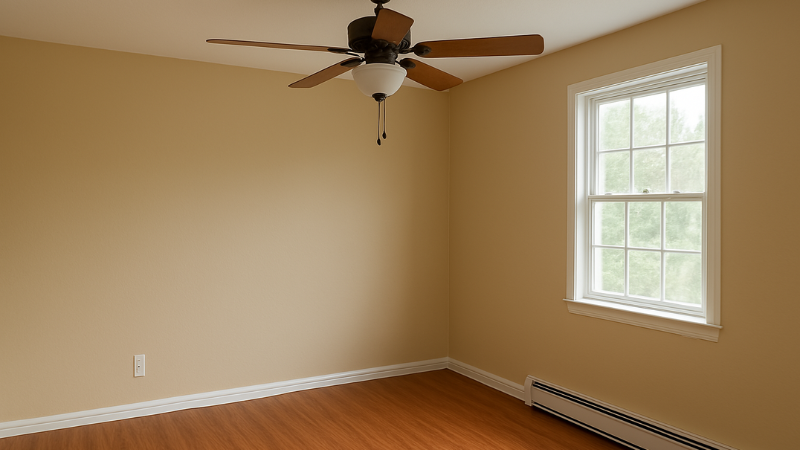
Otherwise, the application of contrasting fan blade color will provide depth and visual interest, with the fan being the room’s focal point.
To achieve a balanced appearance, one should consider the overall room design, including the position of the fan, the color of the wall, and the style of furniture. A balanced mix of similar or dissimilar objects will ensure that the fan blends into the room design without overpowering it.
Ceiling Fan Color Guide for Different Rooms
Choosing the most appropriate ceiling fan color for each room can play an important role in the functionality and appearance of the room. Following is a guide to help you choose the perfect fan color for each room in your home, covering a number of essential points.
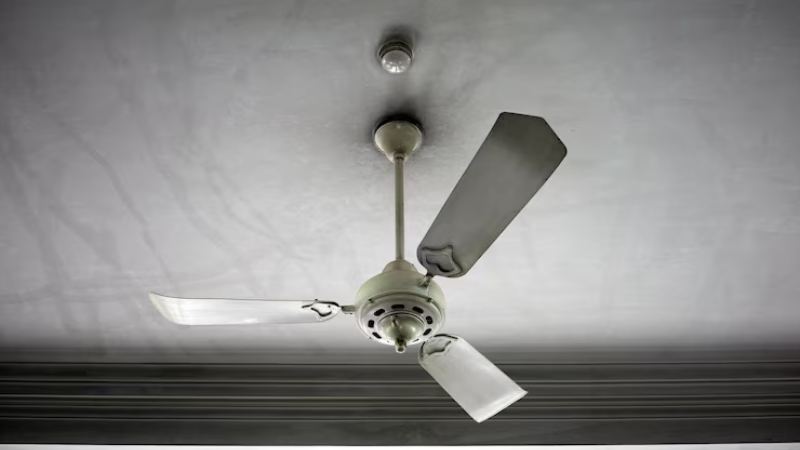
Bedroom: Creating a Calming Atmosphere
Your bedroom is a sanctuary, so a calming atmosphere is key. Soft, neutral colors like white, beige, or light wood tones are ideal for promoting relaxation.
If you want a modern touch, matte black or brushed nickel can add sophistication without overpowering the space.
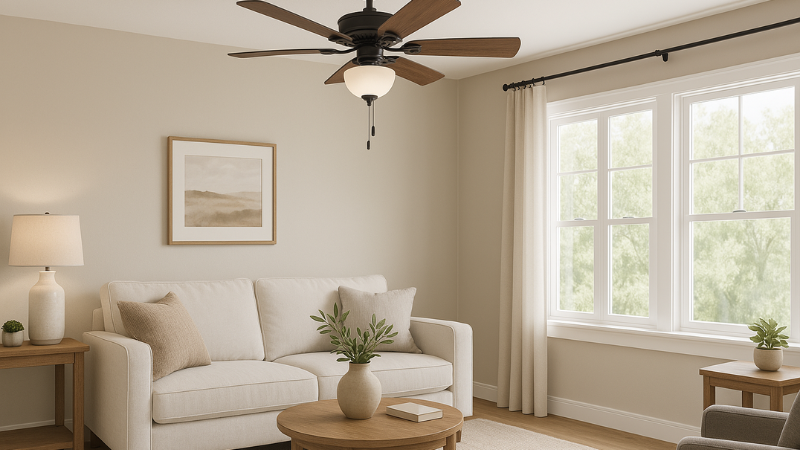
Living Room: Elegance and Functionality
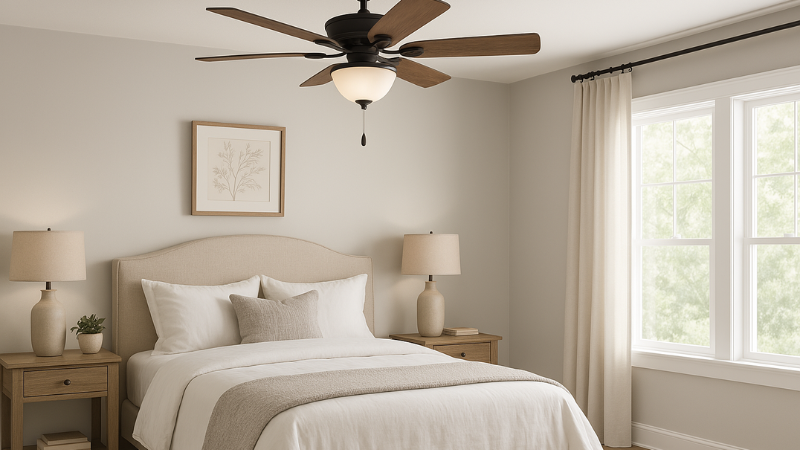
The living room is where style and functionality meet. The best living room fans make the room appear consistent by color-coordinating the fan with lighting and furniture.
Brushed nickel is a go-to to provide a contemporary feel, black fans for a dramatic effect, and wooden fans to provide warmth. Fans of such colors also create a focal point by providing individuality to the room.
Kitchen & Dining Area: Form and Function in Harmony
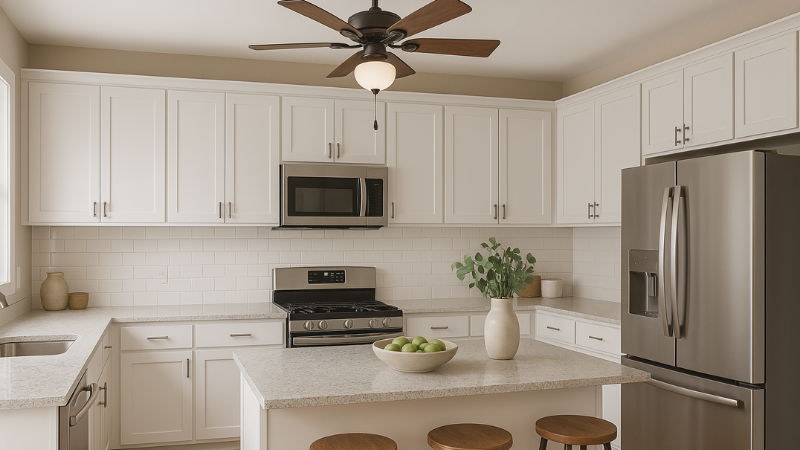
Kitchens, being utilitarian rooms, should have white or brushed nickel fans as the ideal option. Not only do they illuminate the room, but they are also low maintenance, particularly where there is heavy traffic and dust would be an issue.
Wooden fans are ideal for a farmhouse arrangement, while darker shades are ideal for industrial-style kitchen arrangements.
Home Office: Enhancing Productivity and Aesthetics
To create an optimized workspace, choose cool-tone fans that promote focus, such as matte black or brushed nickel. These colors provide a sleek, professional appearance to the space that creates the perfect ambiance of a home office, evoking productivity and environment.
Outdoor & Patio Spaces: Weather-Resistant Aesthetics
Exteriors of a house require weatherproof ceiling fans, and for that reason, weathered wood or dark finish fans are wonderful choices. Aside from the resistance of these colors to fading, they also coexist well in nature, contributing to outdoor livability and decks.
The secret to getting the best ceiling fans is to search for the top manufacturer of ceiling fans. By searching for a good seller, you can get a perfect fan that blends functionality and modernism.

What Ceiling Fan Color Errors Must You Shun?
Choosing the right ceiling fan color is crucial to having a balanced room. In order to avoid making these common mistakes, ensure to go through the pros and cons of ceiling fans:
To ensure your fan enhances your space, avoid these common mistakes:
- Ignoring the Room’s Color Scheme: A fan that clashes with your walls, floors, or furniture can create visual chaos. Always ensure your fan complements the room’s overall color palette.
- Choosing an Overly Bold Shade: While a bold fan can be a statement piece, an excessively bright color can overwhelm the room and distract from other design elements. If you choose a bold fan, balance it with neutral tones elsewhere.
- Forgetting About Ceiling Height and Lighting: A black fan can feel heavy and intrusive in a room with a low ceiling or poor lighting. Conversely, a light-colored fan can get lost in a large, well-lit space. Always consider your room’s dimensions and lighting to get the maximum visual impact.
Ceiling Fan Color Trends for Modern Interiors
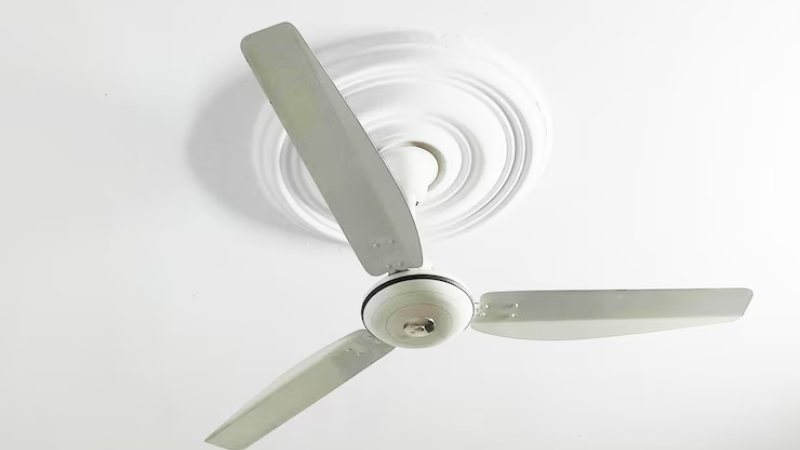
Ceiling fan color trends keep evolving, and homeowners can pick from an enhanced range of interior appearance-improving options. Current trends center around finishes and styles with function and elegance entwined.
- Matte Finishes: Matte white and matte black fans are where modern designs are going.
- Two-Tone Ceiling Fans: Two-tone blade and motor colors for the fans (like black blades on a gold motor) are in vogue these days.
- Natural Elements in Design: Mixing metal and wood materials for a harmonious, nature-inspired look.
Practical Tips for Choosing the Ideal Ceiling Fan Color
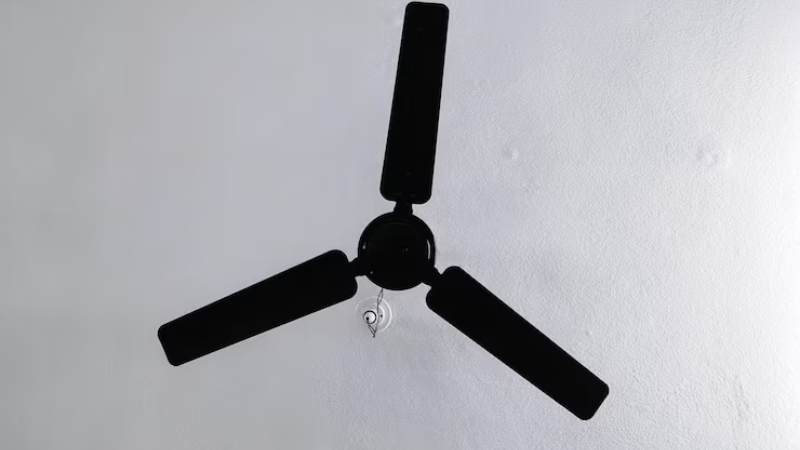
When choosing the ideal ceiling fan color for your room, these practical tips can guide you to select the best outdoor ceiling fan:
- Think about the Room’s Overall Color Scheme: Avoid conflicting colors; choose harmony with walls and furniture.
- Test Samples Before Purchasing: When purchasing online, order small samples or test fan finishes in-store.
- Opt for Neutral Shades When Unsure: White, wood, or gray devotees succeed in almost any room.
- Look Ahead to Future Decor Enhancements: When future decorating is undertaken, select colors that are adaptable and will not limit future design efforts
Conclusion
Choosing the perfect ceiling fan color is the final touch that can make your room’s design feel complete.
By considering your room’s specific style, your existing decor, and the mood you want to create, you can confidently select a fan that’s not just functional, but a beautiful and harmonious part of your space.
Take Your Business to New Heights with World-Class Solutions
We are proud at Risuncorp to offer world-class solutions individually tailored to meet your business’s unique needs.
Are you looking to update your space with cutting-edge technology? Call today for a consultation or quote, and we will show you how Risuncorp can change the way you do business.